
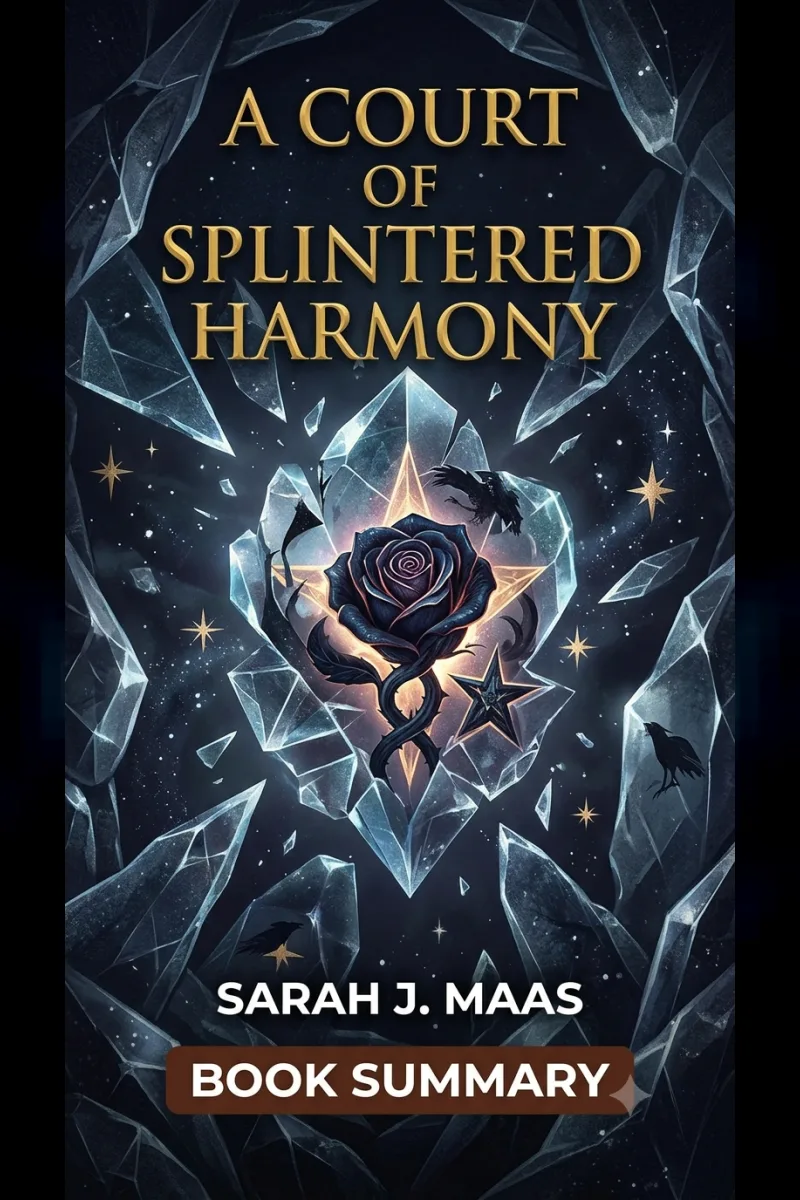
A Court of Splintered Harmony by Sarah J. Maas — The Night Court Faces a New War
Book Summaries
November 10, 2026
By NPOWS New
The war is over, the Night Court has rebuilt, and Feyre has a baby. For readers of Sarah J. Maas's A Court of Thorns and Roses series, that might sound like a happy ending. A Court of Splintered Harmony is built to show that it isn't.
Published by Bloomsbury on 27 October 2026, it is the sixth book in the series that began in 2015 and became one of the most popular romantic fantasy series in the world. It is also, officially, The Valkyrie Cycle, Movement I: the opening of a new story arc that continues in A Court of Forgotten Melody, scheduled for 12 January 2027, which will contain Movements II and III. That label matters, because it explains both what the book does well and why some readers have been left frustrated.
Who it's for
This is not an entry point. It assumes you have read all five earlier ACOTAR books and know the characters well. Maas's Crescent City series also matters here. The two series now share a world, and Bookishelf's review strongly recommends reading House of Flame and Shadow, the third Crescent City book, because the new novel refers back to its events without explaining them. The first two Crescent City books add useful background but are less essential.
Like the rest of the series, it's for adults. A detailed content guide at Bookishelf rates it as open-door romance and lists warnings including violence, torture, child abuse in a character's past and a traumatic birth.
The new threat
Prythian, Maas's faerie land, has a new problem. Koschei the Deathless, long bound to a mountain lake, is spreading his influence and gathering allies, and some Fae powers want to take back the lands where humans now live. The Night Court has to manage tense negotiations while preparing for a danger that most others would rather ignore.
The book's political question is a strong one: should a family that has already paid for one war risk its next generation in another? Bookishelf's reviewer praised Maas for making the negotiations thoughtful, with no easy villains on the other side of the table.
Azriel's book, mostly
Fans have waited years for Azriel, the Night Court's shadowsinger and spymaster, to take centre stage. He opens this book and carries more chapters than anyone else, with other point-of-view chapters from Feyre, Nesta, Cassian and several others. Reviewers describe a darker, more frightening Azriel than the brooding figure of earlier books, and a fuller look at his past.
The romance at the centre is the long-running tension between Elain, the man fated to be her mate, Lucien, and Azriel, who has been drawn to her for several books. This storyline has divided readers more than anything else in the novel. Without saying how it develops, it's fair to warn that even Bookishelf's otherwise enthusiastic reviewer found it unpleasant, with characters behaving badly.
The motherhood thread
The most surprising strength is Feyre's motherhood. Reviewers at both Bookishelf and Fanfiaddict praised its portrayal of life after giving birth, with the exhaustion and fear that fantasy novels usually skip. It's an unusual subject for the genre, and it fits the book's larger theme: what a family owes the next generation.
Why the reviews are so split
Reactions have ranged from delight to real disappointment. Bookishelf's reviewer gave it 4.5 out of 5, calling a major Naming Day set piece some of Maas's best action writing, while admitting that it resolves very little and is "a first movement, not a whole symphony".
Others were much harsher. Smart Bitches, Trashy Books gave it a C-, arguing that it doesn't feel like a complete novel and suggesting readers wait for the whole cycle. Caitlin Lloyd at Fanfiaddict was "underwhelmed": she found it mostly setup, too focused on the fallout of earlier books, and thin on character development, with Cassian having lost his spark and Rhysand more distant than before. Common complaints also include slow middle chapters, secrets held back mainly for dramatic effect, and repeated phrases.
The common thread in all these criticisms is structure. At under 400 pages, the book is short by Maas's recent standards, and it ends where a longer novel would only be getting going. Whether that bothers you probably depends on whether you mind waiting until January for the rest.
Reading order
Essential: A Court of Thorns and Roses (2015), A Court of Mist and Fury (2016), A Court of Wings and Ruin (2017), A Court of Frost and Starlight (2018) and A Court of Silver Flames (2021).
Strongly recommended: House of Flame and Shadow (2024).
Helpful background: House of Earth and Blood (2020) and House of Sky and Breath (2022).
Our verdict
A Court of Splintered Harmony is a promising opening and an incomplete book. Azriel fans and long-time readers will find plenty to enjoy, especially the new threat, the political stakes and the unexpectedly honest motherhood chapters. But it's mostly setup, its love triangle frustrates, and it stops before much is resolved.
If you hate waiting, hold off until A Court of Forgotten Melody arrives and read them together. If you're new to Maas, start with A Court of Thorns and Roses.