
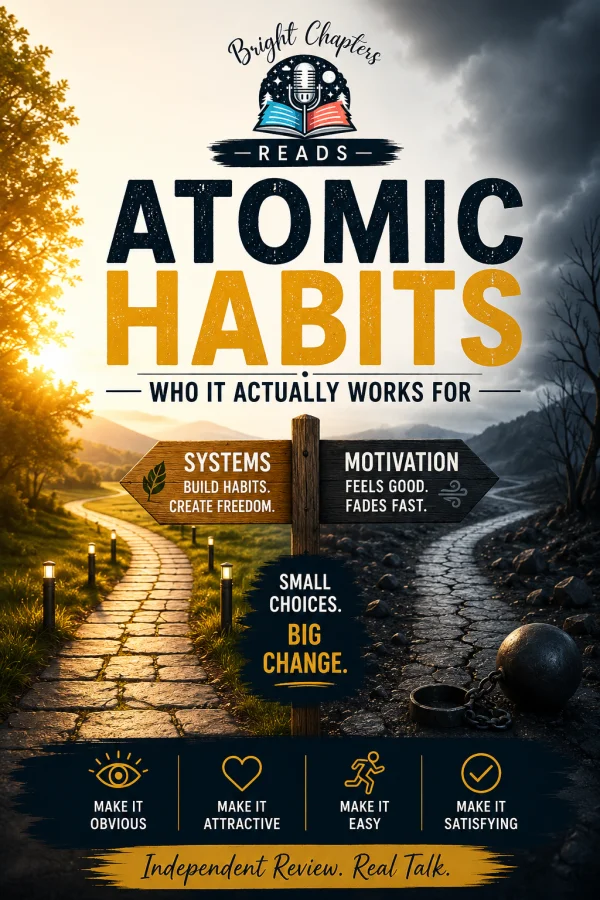
Atomic Habits — Who It Actually Works For
Book Summaries
July 23, 2026
By NPOWS New
People file this book under productivity, but that's not really what it's about. It's about making your behavior automatic, so you don't have to rely on willpower, which runs out, or motivation, which was never something you could count on anyway. Every tactic in the book is really just building toward that one goal.
The mechanism, not the motivation
Most habit advice just tells you to try harder. Clear does something different. He breaks a habit down into four parts: a cue, a craving, a response, and a reward. A habit isn't really a choice you make each morning. It's a loop running in the background, whether you're thinking about it or not. Change one part of that loop and the habit changes with it. You don't need a pep talk to make that happen.
That's the real value of this book. Not "build better habits," but a simple way to see why habits form in the first place. The four laws, make it obvious, make it attractive, make it easy, make it satisfying, aren't just catchy phrases. They're checkpoints. If a habit isn't sticking, you can look at each one and find out exactly what's missing, instead of just telling yourself you're lazy.
Habit stacking is the easiest one to picture. You attach a new habit to something you already do without thinking. After I pour my coffee, I do ten pushups. The new habit rides along on the old one instead of needing its own motivation. It's a simple trick. It also just works, and it holds up on an actual Tuesday morning better than most advice in this genre does.
The two-minute rule uses the same idea a different way. You shrink a new habit down until it takes less than two minutes to start. Not "read for thirty minutes," just "read one page." Not "run three miles," just "put your shoes on." The two minutes isn't the point. Starting is. Once your shoes are on, going for the run is easier than not going.
This part of the book is genuinely good. But it has limits, and the book doesn't spend much time telling you where they are.
The reframe that actually holds up
Clear's other big idea is that your habits are like votes. Every time you do something, you're casting a small vote for the kind of person you think you are. Skip a workout and it's not just one missed session. It's a vote for "person who doesn't work out."
This matters because motivation built around a goal runs out the second you hit the goal, or the second it starts to feel too far away. Motivation built around identity doesn't have that problem, because there's no finish line to reach. You're just slowly building a case for who you already decided you are.
It also explains why "just have more discipline" is such useless advice. It doesn't tell you what to actually do on a random Wednesday. Moving the fruit bowl to the counter and the cookies out of sight does.
One thing worth saying plainly: not everyone thinks the science here is as solid as the book makes it sound. Some critics, including writers at The Guardian, have argued the book presents behavior science with more confidence than the actual research supports. A lot of the four-law model is really old behaviorist psychology dressed up in new language, and the book doesn't always mention how much of that older research is still debated. The tools deserve the praise. The certainty doesn't.
Where the framework quietly stops working
Two places, mainly. This is where the system starts to crack.
The first is compulsion. Moving things around your environment works well for habits built on convenience, like the fridge being right there on the way to the couch, or your phone being within arm's reach. It works a lot less well for habits built on compulsion. Addiction, OCD, and trauma-driven behavior don't always respond to "just move the thing," because the craving isn't really coming from the environment in the first place. Someone struggling with alcohol can pour out every bottle in the house and still end up driving to a store. Clear never claims otherwise. But the book also doesn't spell that out clearly enough, and a reader could easily assume a system this confident works on everything.
If this is your situation, treat the four laws as extra support, not the actual fix. Cutting down how often you're exposed to a trigger genuinely helps, and it's worth doing. But the craving itself usually needs something this book doesn't offer, a therapist, a real program, someone who can actually treat what's driving it.
The second is skill. Rearranging your environment and stacking habits solve the problem of showing up. They don't do much for the separate problem of getting better. The book's famous idea, get one percent better each day and you'll end up close to 38 times better after a year, adds up correctly on paper. But it assumes each repetition is slightly better than the one before it. That's true for something simple like flossing. It's not true for anything with an actual skill involved, an instrument, a sport, writing a sentence. Practice the wrong guitar scale for a year and you don't get a year of improvement. You get very efficient at playing it wrong. You can show up every single day and still plateau, because doing something over and over doesn't automatically make you better at it.
The fix isn't to throw the habit system out. It's to add something the book never gives you, someone else's feedback. A teacher, a coach, an editor, anyone who can tell you which of your four hundred attempts were actually good ones. Use this book to make sure you show up. Get your feedback from somewhere else.
The assumption hiding underneath the whole system
Every habit book, including this one, quietly assumes something that almost nobody says out loud: that you can repeat the exact same thing, in the exact same setting, at roughly the same time, for weeks at a stretch.
There's real research on how long that actually takes, and it's worth knowing before you get started. One well-known UCL study tracked people building a single daily habit in a fixed setting over twelve weeks. The middle point for a habit becoming automatic was 66 days, not the "21 days" number that gets thrown around everywhere. It ranged anywhere from 18 to 254 days depending on the person and the habit, and that was under pretty ideal conditions, a fixed setting picked ahead of time, nothing getting in the way. So if a habit isn't sticking after a week, that doesn't mean the four laws failed you. It just means you're early in something that takes most people two or three months, even when nothing in their life is going wrong. One nice detail from the same study: missing a single day didn't wreck anyone's progress. People got right back on track once they picked the habit back up.
Rearranging your environment only works if you're actually able to rearrange it. Move the cookies, hide the phone charger, put the guitar in the middle of the room. All of that assumes you have a kitchen you're free to rearrange, a schedule with any give in it, a level of stability a lot of people don't have. A nurse working rotating shifts doesn't get a fixed "same time every day" to build a habit around. Someone moving between relatives' apartments doesn't get to permanently rearrange a kitchen that isn't even theirs. Real life doesn't hold still that long.
If your life doesn't hold still long enough for a fixed cue to work, the answer isn't to give up on the idea. It's to move the cue somewhere it can travel with you instead of somewhere fixed. A phone alarm at a set time. An object you always carry. A habit tied to something your body does no matter where you wake up that morning. Instead of "after breakfast," try "after my first cup of coffee," wherever that coffee happens to get made. The idea still works. It just needs an anchor you can carry, not one bolted to a room.
Why readers mistake a useful model for a universal law
Some of this comes down to the reader, not the book. A confident four-law system with a neat little chart is an easy thing to swallow whole. There's something comforting about believing a stuck habit is just a fixable problem with your kitchen setup, instead of something messier, like an unstable schedule, a compulsion, or a skill gap that really needs another person's eyes on it. The kitchen explanation gives you something to do. The messier ones usually don't, at least not from a book alone.
But some of it really is the book's own doing. It rarely stops to say "this works well here, and less well there." It reads like a system with no edges at all, and that confidence is part of why it sold better than everything else in this category. A reader who's only ever seen the success stories has no reason to expect there are limits, until they run into one themselves. Most people blame themselves at that point, not the book's silence about where it stops working.
So is it worth reading?
Yes, for a specific job. If your problem is getting started, breaking a habit built on convenience, or just staying consistent with something simple and repeated, this is close to the best version of that kind of book you'll find. The four laws are real, the tactics are specific, and anyone who keeps starting a habit and losing it two weeks later will get real, immediate use out of this.
It's not a full theory of how people change, and it was never trying to be one. It doesn't have much to offer someone whose real problem is instability rather than laziness, someone whose habit is a compulsion rather than a convenience, or someone chasing a skill rather than a routine. The book isn't lying about this. It just doesn't say it loudly enough, and a reader who takes the confident tone at face value can end up blaming themselves for a gap the system was never built to close.
Read it if staying consistent is your problem, not if you're after a deep dive into behavior science. Pair it with real practice, a coach, or an editor if what you actually need is skill rather than routine. Pair it with a therapist or a real program if what you're fighting is compulsion rather than convenience. The book does its part well. Figuring out which part is yours to bring is the part it leaves out.