
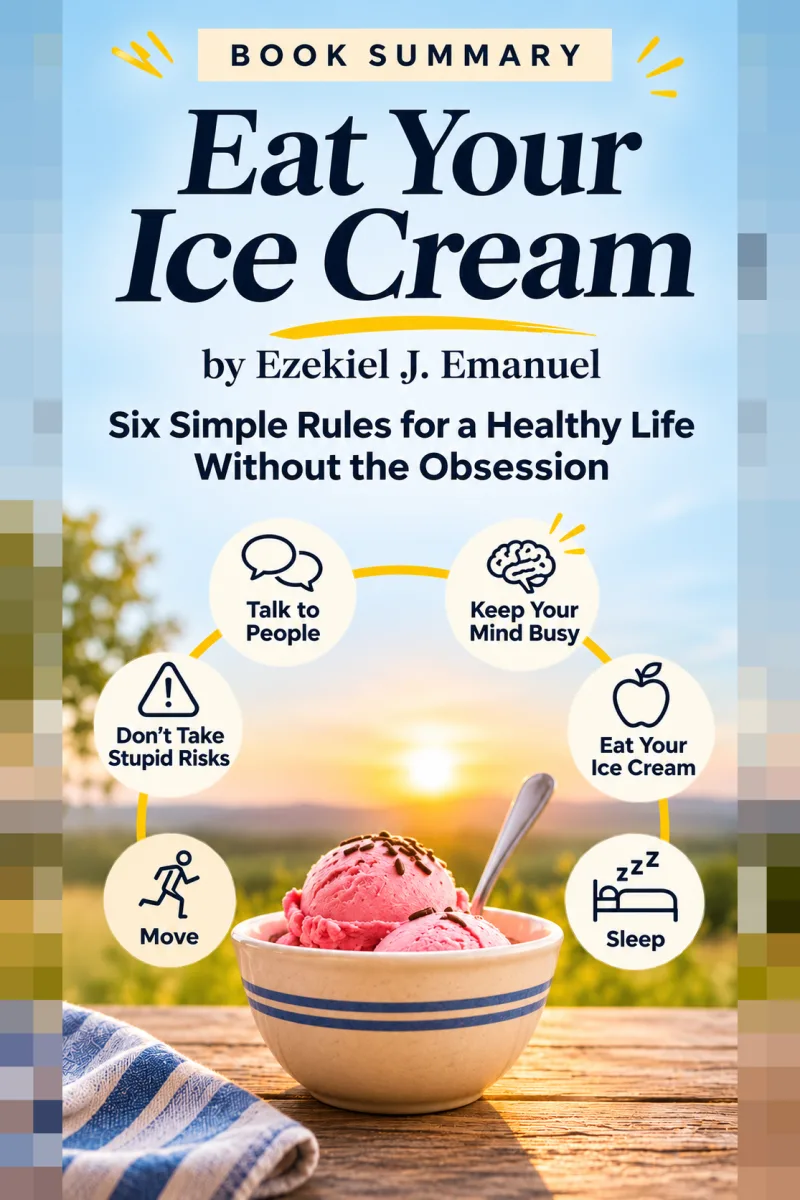
Eat Your Ice Cream by Ezekiel Emanuel — Six Simple Rules for a Healthy Life Without the Obsession
Book Summaries
November 1, 2026
By NPOWS New
Ezekiel Emanuel is an oncologist, a bioethicist at the University of Pennsylvania, and a former White House health adviser, and he's tired of what he calls the "wellness industrial complex." Peptide injections, full-body scans, anti-aging supplements, sleep trackers, cold plunges: an entire industry has made staying healthy feel like a second job, and an expensive one. His book is a deliberate step back. Most of what keeps people healthy, he argues, is simple, cheap, and well supported. In interviews about the book he's put a number on it: spending ten hours a week on wellness is excessive, and two or three should be enough.
He also has a particular view of what the goal is. Emanuel is known for his controversial 2014 essay, Why I Hope to Die at 75, in which he questioned the pursuit of longevity for its own sake. He later clarified that he wasn't advocating an early death, but questioning how much medical intervention is worthwhile when its only purpose is to extend life. So this isn't a longevity book in the biohacking sense. It's about health that supports a good life, rather than consuming it.
Rule one: Don't Be a Schmuck
The biggest threats to a long, healthy life aren't missing the latest superfood. They're the obvious, avoidable dangers: smoking or vaping, heavy drinking, and distracted driving, which Emanuel points out is one of the most dangerous things most people do every day.
On alcohol, he recommends keeping it to around three or four drinks a week. That's his practical limit, not a scientifically established safe level. Even small amounts of alcohol carry some health risk, including cancer risk, and the World Health Organization says no level of drinking can be called risk-free.
He also wants people to think about risk more like a statistician: compare an activity's danger to things you already accept, like driving, and take reasonable risks while avoiding unreasonable ones. Climbing Mount Everest, with its real chance of serious injury or death, falls firmly in the second category.
Rule two: Talk to People
This is the rule Emanuel considers most important, and the one he thinks wellness writers neglect most. Large studies covering millions of people link social isolation to a noticeably higher risk of early death. Those are associations rather than proof that isolation alone is the cause, and being isolated isn't the same as feeling lonely, but the pattern is consistent. The long-running Harvard Study of Adult Development points the same way: close relationships are among the strongest predictors of health and happiness in later life.
His advice is practical and slightly old-fashioned. Start conversations, even with strangers. He asks his drivers where they're from. Most people respond warmly when someone else takes the first step, and those small exchanges add to a sense of connection alongside your closer relationships.
Rule three: Expand Your Mind
Emanuel says he fears losing his mind more than losing his body, and he treats mental engagement as a health habit like any other. Genes matter, but so do curiosity, learning, social contact, and having a reason to get up in the morning. Research has linked a stronger sense of purpose with a lower risk of cognitive impairment, though that doesn't show purpose alone prevents it.
He pays particular attention to retirement. Work quietly provides structure, purpose, and social contact, and retirement can take all three away at once. For some people, especially those leaving stressful or physically hard jobs, retiring improves their wellbeing. Emanuel's point is that it shouldn't be left to chance: plan how you'll replace what work gave you, through volunteering, classes, clubs, or a serious hobby. His example is Benjamin Franklin, still sharp and influential at 81 when he signed the US Constitution.
Rule four: Eat Your Ice Cream
The book's title comes from the food chapter, and its spirit is enjoyment over anxiety. Eat mostly real food, get much more fibre than most people do, cut back on sugary drinks and packaged snacks, and keep treats for the end of the day rather than all day long. He recommends including fermented foods like yogurt, kimchi, and sauerkraut, though how many live cultures they contain varies a lot from product to product.
Then there's the ice cream. Some observational studies have found an unexpected link between eating ice cream and lower rates of type 2 diabetes, which researchers have nicknamed the "ice cream paradox." Emanuel is careful to say this doesn't mean ice cream prevents diabetes; people who eat it may differ in plenty of other ways. His real point is simpler. A treat you enjoy, eaten in moderation, won't undo a healthy life, and guilt about food does its own damage. He also prefers simpler ingredient lists with fewer additives, though the evidence that particular additives harm people at normal amounts is still limited.
Rule five: Move It!
Exercise gets a no-frills treatment. Combine activity that raises your heart rate with strength training, and break up long periods of sitting. One of his favourite small habits is a walk after meals. Research suggests even a short walk soon after eating can reduce the blood sugar spike that follows, and it's an easy way to get up from the table and moving. You don't need a gym membership or a fitness tracker for any of it.
Rule six: Sleep Like a Baby
Sleep supports memory and a range of the body's restorative processes. Scientists are also studying how sleep may help the brain clear waste, though how that works in humans is still being worked out. Emanuel points to research showing that cutting sleep short increases hunger and how much people eat, which can lead to weight gain over time.
He's sceptical of sleeping pills as the default fix. For long-term insomnia, medical guidelines recommend cognitive behavioural therapy for insomnia, known as CBT-I, as the first treatment to try, with medication considered in some cases. For most people, though, the starting point is the basics: a consistent bedtime and a bedroom set up for sleeping.
Where it needs adjusting
The most consistent criticism from readers fits a pattern seen in many health books: the advice is written for a fairly average, fairly comfortable reader. Someone with time to cook, a safe neighbourhood to walk in, a body that can exercise freely, and a social life to build on. It also assumes a fair amount of control over working hours, food, and living conditions, which shift workers, people on low incomes, and many carers don't have. Readers with chronic illness, disability, or serious mental health challenges may find less in it for them, and "keep it simple" is harder to apply when your situation isn't simple.
Two specific points are also worth knowing. First, the book is quite dismissive of supplements as a category. That's fair for the anti-aging pills it's aimed at, but some people genuinely need them: vegans who need vitamin B12, people with diagnosed deficiencies like iron or vitamin D, and women around conception and early pregnancy, who are advised to take folic acid. If a doctor has told you to take something, this book isn't a reason to stop. Second, some of the evidence it draws on, like the ice cream finding and studies of long-lived "Blue Zone" communities, is observational. These studies can show patterns linked to long life, but they can't show which habit caused it, and some of the longevity data has been debated.
So is it worth reading?
Yes, especially if the wellness world has started to feel exhausting. This is one of the most sensible health books in years: evidence-based, funny, and refreshingly free of things to buy. Its biggest contribution is putting social connection and mental engagement on the same level as diet and exercise, where most health books barely mention them.
If you already eat reasonably, move most days, and sleep well, much of it will confirm what you know, and that's part of its point. You probably don't need a new protocol. You need to keep doing the simple things, call a friend, find something that keeps your mind busy, and enjoy the occasional bowl of ice cream without guilt.