
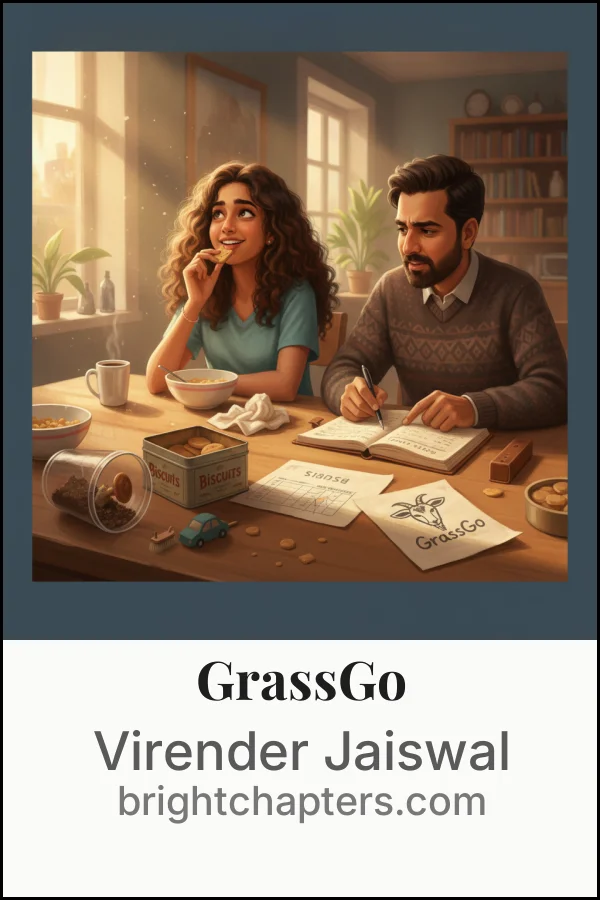
GrassGo
Relationships
July 18, 2026
By Virender Jaiswal
Riya walked into the kitchen, poured herself a cup of coffee, and reached for the biscuit tin.
She took one bite.
"Hmm..."
Her mother did not look up from the potatoes. She had been peeling potatoes for thirty years. She could detect a business idea from two rooms away.
"I know that 'hmm.'"
"What 'hmm'? I didn't say anything."
"You said hmm."
"That's just a sound."
"That sound cost us fourteen thousand rupees when you decided to sell handmade soaps from the bathroom."
Riya opened her mouth.
"The bathroom still smells of lavender," her mother added. "It has been four years."
Riya closed her mouth. Then opened it again, because she was constitutionally unable not to.
"Biscuits haven't changed in years."
"They're biscuits."
"But imagine if—"
"No."
"You don't even know what I was going to say."
"Healthier. Organic. Premium. Sell online. Disrupt the category." Her mother peeled a potato with the calm of someone who had given this speech before. "Did I miss anything?"
Riya stared at her.
"...Subscription model," she said quietly.
Her mother put down the peeler. Not aggressively. Just with the weight of a woman who needed a moment.
"Last week," she said, "mushroom farm."
"I watched one video. It was very convincing."
"The week before, mobile car wash."
"People need clean cars, Mummy."
"And before that, you wanted to rent goats."
A pause.
"To eat weeds," her mother clarified, in case Riya had forgotten the details. "You wanted to charge people to borrow goats. To eat their garden weeds. As a service."
"Agri-tourism is a growing sector—"
"Riya."
"The goats basically do the work themselves—"
"Riya."
"I had a name for it and everything. GrassGo."
Her mother picked the peeler back up. This was her coping mechanism. As long as there were potatoes, she could survive anything.
Her father walked in at this precise moment, which was either terrible timing or a gift from God, depending on who you asked.
He was still in his reading glasses. He had a newspaper under one arm and the expression of a man who had heard everything from the hallway and was choosing, wisely, to pretend otherwise.
He looked at his wife. He looked at his daughter. He looked at the biscuit tin on the counter.
"What are we opening today?"
This was not a joke. He asked this every time. It had started as a joke, years ago, and had since become simply how mornings worked in this house.
"A biscuit company," said her mother.
He set down his newspaper. Took off his glasses. Polished them on his shirt — which he only did when he was thinking seriously — and put them back on.
"Good. We already have customers."
Riya looked at him. "We do?"
"Our family. Three packets a week. I checked."
"You checked?"
"I keep a rough household expenditure log." He said this as if it were completely normal. Because for him, it was. "Biscuits are the fourth largest recurring cost after groceries, electricity, and your mother's insistence on buying whole spices when the ground ones work perfectly well."
"I heard that," said her mother.
"It was meant to be heard." He sat down at the table. "Three packets a week is one hundred and fifty-six packets a year. Multiply that across even a small apartment complex—"
"Papa."
"I'm just saying the unit economics are interesting."
Riya turned to her mother with the expression of someone who had just discovered their accomplice had been hiding in plain sight for thirty years.
Her mother pointed to the chair. "Sit. Both of you, sit."
They sat.
She reached into the tin, held out a biscuit to Riya, and said nothing for a moment. Just looked at her daughter — this ridiculous, wonderful, exhausting person she had made — with the kind of love that doesn't have a cleaner word for it.
"Do you want one more?"
Riya took it.
"For the next ten minutes," her mother said, "you are not the founder of anything. You are not disrupting any category. The goats are retired. GrassGo is not happening."
"What am I then?"
"A customer. Eating a biscuit. That's all."
Riya dipped it into her coffee and ate it.
The kitchen was quiet.
Her father had, very discreetly, taken out a small notebook. He was not writing in it. He was simply holding it. Just in case.
Her mother looked at him. He put the notebook away.
She looked back at Riya.
"I think we're safe," she whispered.
Riya stared at the tin. Then at the shelf behind it, where three other brands sat in a row. Same beige. Same font. Same picture of wheat doing nothing interesting.
She swallowed the last of the biscuit.
"...Although. Look, Papa already sees it. Three packets a week, you said it yourself. That's not a habit, that's a dependency. We're not selling biscuits, we're selling the thing people reach for without thinking—"
Her father nodded slowly. "The repeat purchase rate alone—"
"Exactly! And if we go healthier, we open a whole new—"
"The margins on premium could be significant—"
"Papa gets it. Papa completely gets it."
They were both leaning forward now. The notebook was back on the table. Riya was gesturing at the tin. Her father was nodding in the way he nodded when something made numerical sense to him.
Her mother set down the peeler.
She looked at her daughter. She looked at her husband. She looked at the biscuit tin sitting between them like it had called this meeting.
"Shut up," she said.
They shut up.
She picked up the peeler again.
But she was smiling. Just a little. Just enough.