
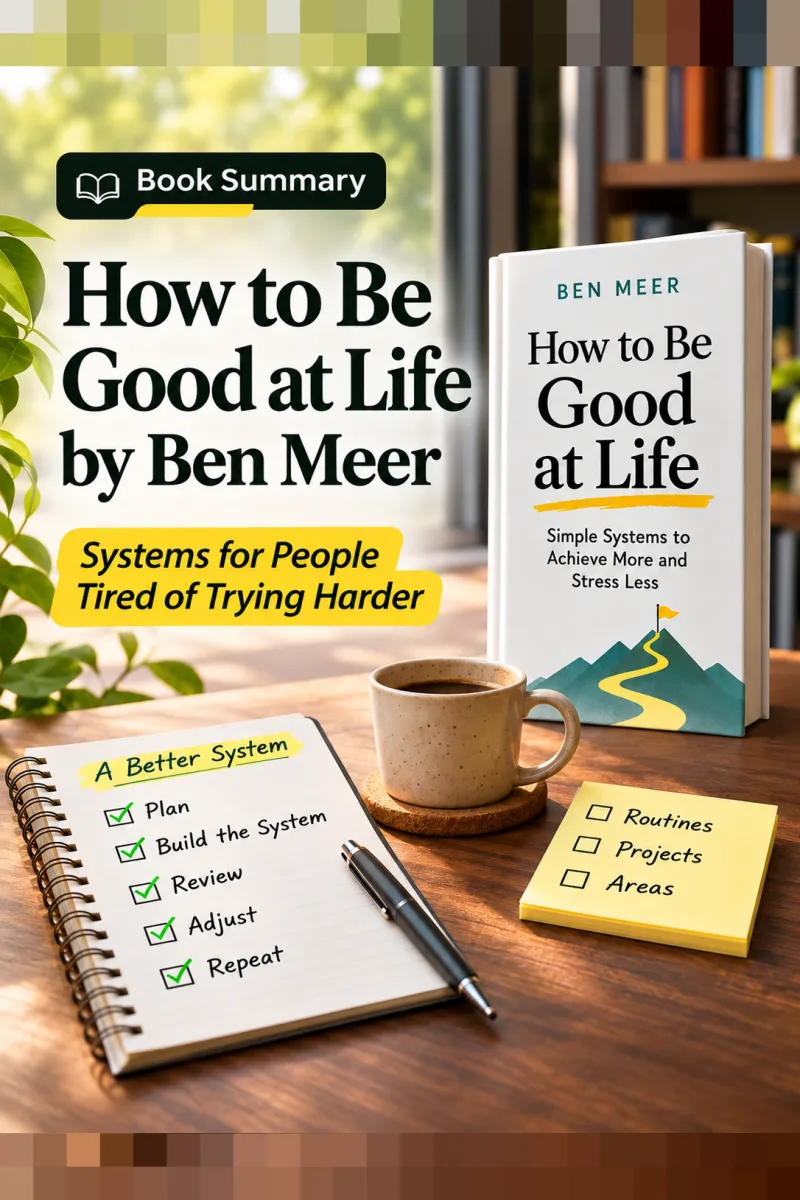
How to Be Good at Life by Ben Meer — Systems for People Tired of Trying Harder
Book Summaries
November 1, 2026
By NPOWS New
Ben Meer's book starts from a frustration most people know well. You set a goal, you get excited, you push hard for two weeks, and then life gets busy and the whole thing quietly falls apart. His answer is that the problem was never your willpower. It was that you were trying to run your life on effort instead of on systems, and effort runs out.
A system, in Meer's sense, is anything that makes the right action happen without you having to decide it again every day. A checklist, a calendar block, an automatic transfer, a weekly review. Habits are part of it, but only part. Once enough of your life runs on things like these, fewer things depend on remembering, forcing, or feeling like it.
Three kinds of system
Meer organises the practical work of running a life into three categories. Routines are the things you repeat, like exercise, sleep, or a weekly money check. Projects are one-time pushes with a finish line, like changing jobs or writing a book. And areas are the ongoing parts of life you have to keep healthy, like your relationships or your finances.
His short version is that routines protect your floor and projects raise your ceiling. Routines keep the basics from slipping when life gets hard. Projects are how you actually move forward. Most people mix the two up, treating a big goal like a habit, or trying to make every routine feel like a breakthrough, and end up doing neither well.
He also suggests running ambitions as ninety-day projects, one at a time, each with a real finish date, an idea close to the twelve-week cycle in The 12 Week Year. Longer goals get cut into ninety-day phases, so there's always a near enough finish line to work toward.
DRIVE: how to build any system
The core of the book is a five-step method for designing a system for any problem.
Define comes first: one concrete outcome with a date on it, not a vague wish. Reverse engineer means working backward from that outcome into milestones, then weekly blocks, then today's action. Implement is building the routine so it survives bad weeks, travel, and illness, not just good weeks. Validate means checking on a fixed schedule whether the system is actually producing the result. And evolve means treating your first version as a prototype, keeping what works and cutting what doesn't.
The useful twist is that Meer ties each common way of failing to a missing step. The enthusiastic start that fizzles out usually skipped Define. The foggy middle, where you've lost track of what to do next, skipped Reverse Engineer. Doing it some weeks and not others is an Implement problem. Working hard without knowing if it's working is a Validate problem. And a system that worked last year but feels stale now never got Evolved. Real failures usually have more than one cause, but if you can see where your last attempt broke down, DRIVE gives you a good starting point for what to redesign.
He borrows Gall's Law to keep people from overbuilding: start with the simplest system that can work, then let it evolve as you learn what the problem actually needs. A meal-prep system starts with a few prepared meals and one protected prep slot, not a twelve-tab spreadsheet.
The Life Engine audit
Before building anything, the book asks you to look at your whole life. Meer divides it into seven "life engines": physical health, emotions, mind, relationships, career, money, and environment. You picture what a ten would look like in each, rate where you are now from one to ten, and look for two things. Ripple effects, where one weak area is quietly dragging others down. And hidden strengths, where one strong area can fund change elsewhere.
Then comes the most practical instruction in the chapter: pick one engine to push this season and keep the others at maintenance. You can't overhaul everything at once, and trying to is how most self-improvement plans collapse.
Fix the cause, not the symptom
One chapter is about finding the real problem before building a system around the wrong one. Meer uses tools like asking "why" three times in a row, looking at your own problems as if you were an outsider describing them, and noticing the "tomorrow tax," the hidden cost of relieving a symptom today instead of solving the problem underneath it. He also includes a short method for questioning beliefs that hold people back, like "I'm too old to start" or "asking for help is weakness." And he's clear that deep-rooted problems or trauma need a qualified therapist, not a framework.
Getting started and staying on track
The middle of the book is full of small, specific tools.
The fifteen-minute test: if you can't name something you could finish in the next fifteen minutes, your plan is too vague to start. Plan like a bank robber: picture the goal, list what will get in the way, and decide your response to each obstacle in advance. Chosen constraints: make the right choice the default by changing your space, calendar, or accounts, and match the constraint to the failure, distance for cravings, deadlines for open-ended work, a partner for follow-through.
Automation gets its own chapter. Pay bills automatically, move savings on payday, split each paycheck by fixed percentages, and decide in advance where future raises will go. Pre-decide how you'll say no to repeat requests. Hire help once the hours it frees are worth more than it costs. But keep judgment, relationships, and creative work in your own hands.
On tools, the rule is simple: build the routine first, then buy the equipment. Judge a tool by the hours it gives back, and cap your research at six options and a deadline.
System Sunday
The book's signature habit is a weekly hour of review. Look back at the week, starting with what went well. Compare what you committed to with what actually happened. Then decide what will make next week work, and block sleep, exercise, and time with the people you love before work fills the calendar. When you're behind, the rule is to change the system, not to promise yourself you'll try harder. Track one meaningful number a week, not a dozen every day, and give a working system enough time to show results before you tinker with it.
Where it fits, and where it doesn't
This is a well-built book, and most of it holds up. Two things are worth knowing before you buy it.
The first is that it's written for a particular kind of week. System Sunday assumes a free hour every Sunday. "Saturdates" assume a weekend and a partner. Friday Highlights, a weekly email summarizing your wins to your manager, assumes an office job with a manager who reads email. Ninety-day projects assume you control enough of your own time to commit to one. That fits a salaried professional well. It fits less neatly if you're a parent of young children, a caregiver, a shift worker, or someone on irregular gig work, where the week itself is unpredictable. The ideas still apply, but you'll need to translate them: a review on whatever day is calmest, a shorter project cycle, systems built around the time you actually have rather than a standard week.
The second is that if you've already read Atomic Habits, Deep Work, or Getting Things Done, a fair amount of this will feel familiar. Habit stacking and environment design come from the habit books, the weekly review is a core idea in Getting Things Done, and the ninety-day cycle echoes The 12 Week Year. What Meer adds is the organization: one method that ties them together, a way to diagnose why a past attempt failed, and the reminder to work on one area at a time. For a reader new to this kind of book, that makes it one of the best starting points available. For a seasoned reader, the value is in the DRIVE diagnosis and the life audit more than in the individual tactics.
So is it worth reading?
Yes. It's a genuinely useful book, particularly for people who have collected plenty of productivity advice but struggle to make it stick. Its biggest strength is integration: instead of treating habits, projects, planning, and automation as separate tricks, Meer shows how they fit together, and it moves the blame for repeated failure off you and onto the design.
Just keep one distinction in mind. A better system can fix poor planning, but it can't create time, money, or control you don't have. Knowing which of those is your real problem matters as much as knowing how to build a system.
Read the first four chapters carefully, do the life engine audit honestly, and pick one area for the next ninety days. Then build one simple system with DRIVE and review it every week. That alone is worth the price of the book.