
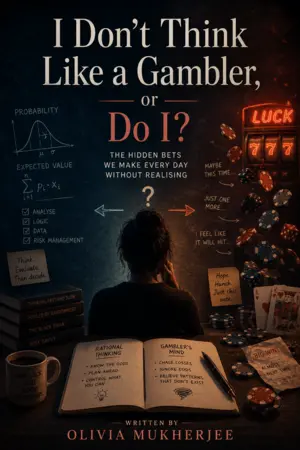
I Don't Think Like a Gambler, or Do I?
Non-Fiction
May 1, 2026
By olivia.mukherjee1986
I looked at my phone for the fifth time in thirty minutes. Still nothing. Which was fine. People get busy. I knew that. I even believed it, for about four minutes, which is exactly how long I managed to keep the phone face-down on the table before I turned it back over.
If you've never been here, put this down. Genuinely. You're better off. This isn't for the sorted, will-powered people sitting peacefully on the other half of the couch. Good for them. This is for everyone else. Welcome to the gang.
Because here's the thing: I've done this in more places than I'd like to admit. It's not just about a person. I've done it with a post I put up at noon, refreshing by 12:07, quietly devastated by 12:15. I've done it with a message I sent that got a read receipt and nothing else.
The phone is just where the loop is most visible.
And it is a loop. You wait. You check. You talk yourself down. You check again. Eventually something breaks, either it lands, or it doesn't, and you feel like hell either way, because by then you've wanted it too long. Then, after a few days, you move on. You find the next thing to orbit.
The next near miss.
Do you see it now? All of them kind of seem like a near miss.
So, me being me, I dove deeper. Because apparently, I'm always busy but have unnecessary time to overthink.
In the 1950s, psychologist B.F. Skinner found that pigeons kept pecking obsessively when food came at random intervals, even after rewards stopped entirely. The strongest behaviors don't come from getting rewarded every time, but from getting rewarded sometimes, unpredictably.
Do you know what else follows the same principle?
Gambling (slot machines)
Social media notifications
Mobile games and reward loops
Even toxic relationships sometimes
The idea being:
You don't get rewarded every time
But you get rewarded just enough to keep going
That's the "maybe next time." The "next post." The "next hour."
What's unfortunate is, your phone knew this before you did.
But here's the thing about a near miss: it doesn't feel like rejection.
Rejection has a shape to it. The door swings shut. There's a sound. Something ends, and you can move. A near miss gives you none of that. The door is still open. Just barely. Just enough that light comes through the crack, and you can't look away from it. Just enough that every time you think about walking away, you think: but what if I left one minute too early?
Think about it...
The slot machine was not designed to make you win. Everyone knows that. The house always wins, that's not a secret. But what most people don't realize is that the slot machine was also not designed to make you lose.
It was designed to make you almost win. Constantly. Scientifically. On purpose.
The near miss. Two cherries and then a lemon. The wheel that stops one click past the jackpot. Game designers figured out decades ago that a near miss activates more dopamine in the brain than either winning or losing cleanly does. You feel more when you almost get it than when you actually get it, or when you never had a chance.
So they engineered the machine to almost give it to you, over and over, because that almost is more addictive than the win itself.
And when I read that, I immediately stopped thinking about casinos.
Because I started thinking about everything else.
So here is the uncomfortable thing I keep coming back to.
We have built a world that is almost entirely structured around the near miss. The variable reward. The suspended outcome. And we did not do this by accident. We did it because it works. It works on our attention, on our wallets, on our emotions, on our time. Designers know it, marketers know it, and the people who build apps know it.
And most of us are walking around genuinely believing that we are making free choices about where we put our energy, our hope, our attention. When actually a very significant portion of those choices are responses to a system that was specifically engineered to exploit the most ancient part of our psychology.
The part that learned, somewhere deep in our evolutionary history, is that the uncertain outcome is worth more attention than the certain one. Because in the wild, uncertainty meant something was still possible. And the possibility was worth staying alert for.
That instinct kept our ancestors alive.
Now it keeps us checking our phones at midnight and replaying conversations from three years ago and applying again to the company that already said no twice.
Here is the only thing that actually helps, as far as I can tell.
The moment you can see the mechanism; it loses a little of its grip. Not all of it. But some. When you catch yourself three days deep into analyzing why someone left you hanging, you can say to yourself, I am not doing this because it makes sense, I am doing this because my brain was built to fixate on unresolved things. Something shifts slightly. You are no longer just inside the feeling. You are also watching it. And trust me, you are allowed to walk away.