
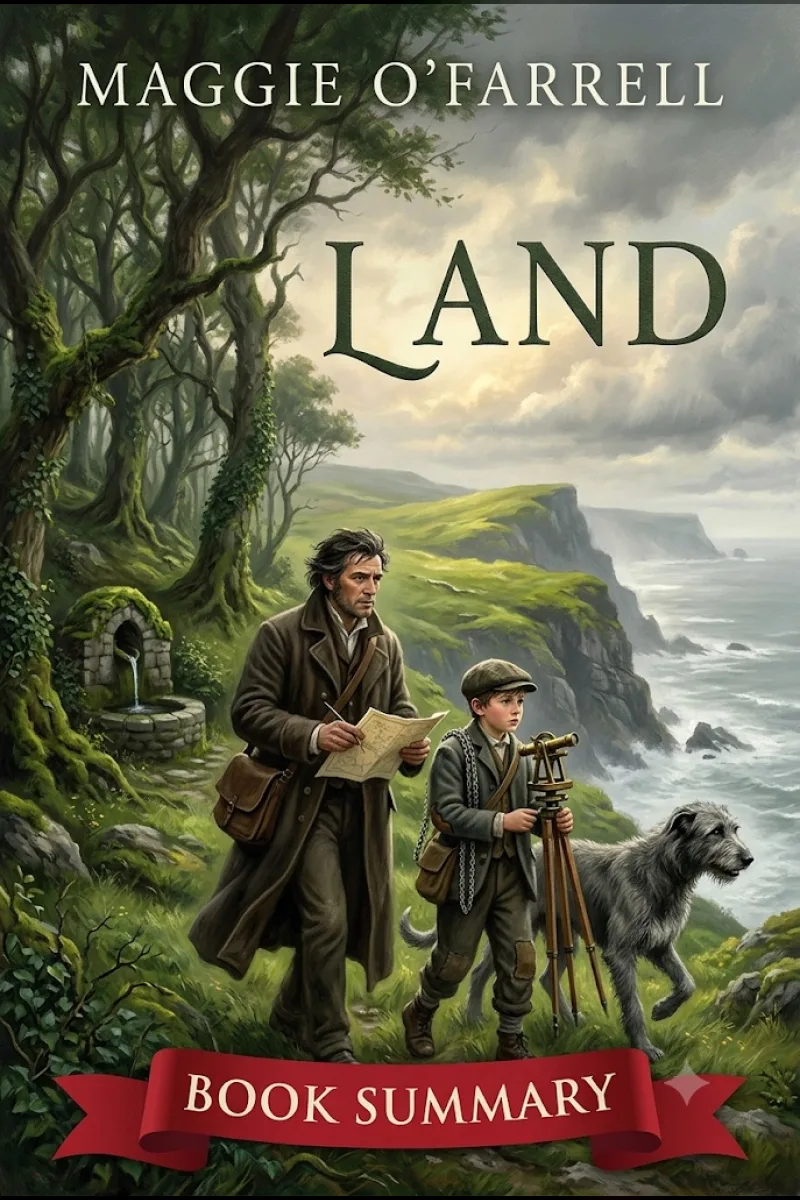
Land by Maggie O'Farrell — A Mapmaker, His Son and a Story Rooted in the Irish Earth
Book Summaries
November 16, 2026
By NPOWS New
In 1865, on a windswept peninsula on Ireland's Atlantic coast, a cartographer named Tomás and his reluctant ten-year-old son, Liam, are working for the Ordnance Survey, mapping the land for the British. Tomás grew up in a workhouse, survived the Great Hunger and has his own reasons for taking the job: he wants his maps to record what the famine did to the country. Then, after drinking from a sacred spring in an ancient wood, he changes, and he moves his wife, Phina, and their children to a cottage among the trees, in a place full of old traditions and older magic. From there the novel follows the children as they grow up, leave home and go out into a much wider world.
Land was published on 2 June 2026 by Tinder Press in the UK and Knopf in the US. It is Maggie O'Farrell's tenth novel, following the international bestsellers Hamnet and The Marriage Portrait, and it went straight to number one on the Sunday Times bestseller list.
An epic told like a fable
Her UK publisher calls it her most ambitious novel, and it is easy to see why. It moves across decades and continents, from the Irish coast to Dublin, Rome, Quebec and India, and reaches back into Ireland's deep past through the legend of a sacred well. Liam's sister Enda crosses the Atlantic to Quebec disguised as a boy, and a loyal wolfhound named Bran keeps the family company. Irish words run through the text, and the book borrows the voice of the traditional storyteller, the seanchaí, so it often reads more like a legend than a conventional novel.
What critics loved
Reviewers praised the sheer richness of the writing. Bookreporter called O'Farrell "a wondrous storyteller", and The Spectator admired how closely language and landscape are connected. The book's themes of faith, family, memory and belonging to a place give it real emotional weight.
Where it divided critics
Land has also had mixed reviews. Writing in The Guardian, Melissa Harrison felt it was ambitious but uneven, with little direct dialogue and a sequence of events that can feel episodic. The Spectator found some characters' motives unexplained and felt the portrait of Ireland sometimes came close to the whimsical. Readers who loved the close focus of Hamnet should expect something broader and more dreamlike.
Who will enjoy it
Land is for readers who enjoy sweeping historical fiction, Irish history and folklore, and prose that rewards slow reading. If you loved Hamnet's language and are happy to follow a family across a whole century, settle in with this one.