
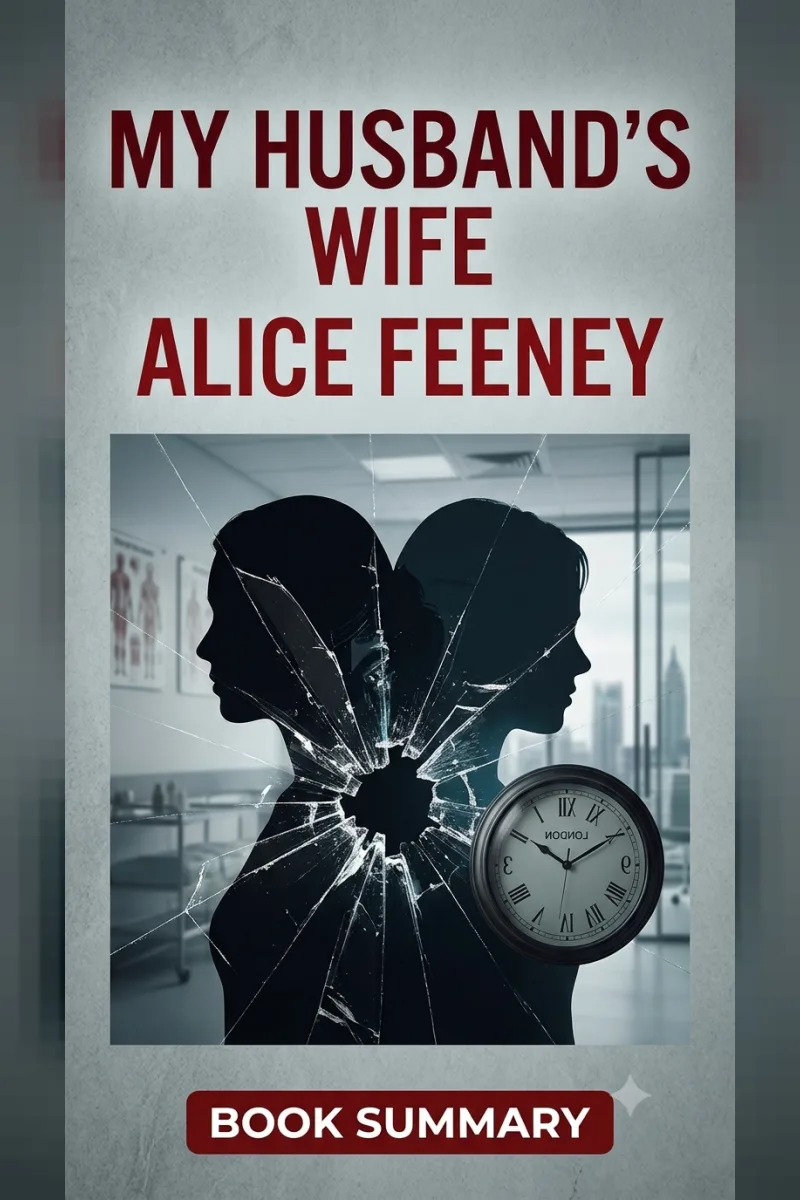
My Husband's Wife by Alice Feeney — A Thriller About Identity, Secrets and a Door That Won't Open
Book Summaries
November 10, 2026
By NPOWS New
On the day of her first art exhibition, Eden Fox goes for a run. When she gets home, her key doesn't fit the door. A woman about ten years older than her opens it and says, quite calmly, that she is Eden Fox. Then Eden's husband, Harrison, comes into the hall, looks at the real Eden and says he has never seen her before.
That's the first chapter of My Husband's Wife, published by Flatiron Books on 20 January 2026. Few thriller openings are this simple or this frightening, and Alice Feeney, who worked at the BBC for many years before writing fiction, knows exactly how to use it. Her earlier novels, including Sometimes I Lie, Rock Paper Scissors and Daisy Darker, built her reputation for unreliable narrators and late reversals. This one is perhaps her most puzzle-like yet.
Two timelines, one house
The novel runs on two tracks. In the present, Eden tries to prove she is who she says she is. She has been shut out of Spyglass, the house on a hill above Hope Falls, a small seaside village in England, and the people who should know her are siding with the stranger. Her eighteen-year-old daughter, Gabriella, can't help. Since a tragic accident she has barely communicated, and she now lives in a care home.
The second timeline begins six months earlier with Birdy, a solitary woman in London who has just learned that she is dying. Soon after her diagnosis, she discovers that a grandmother she never knew existed has left her Spyglass. Birdy moves to Hope Falls with one aim: before she runs out of time, she wants to put some old wrongs right. A London clinic that claims it can predict when people will die plays a part in her story, and in the secrets that link her life to Eden's.
How those two stories fit together is the puzzle, and Feeney keeps the answer hidden for as long as she can.
The fear of not being recognised
The book's most unsettling idea is how much our identity depends on other people. Eden has no way to prove who she is from the inside. She needs her husband, her neighbours and her own front door to confirm it, and when they refuse, the ordinary details of domestic life become threatening. A house is supposed to be the one place where you don't have to explain yourself.
Birdy's story turns the same fear around. She knows exactly who she is, but she has been invisible for most of her life, and her diagnosis gives her a deadline to matter to someone. Where Eden is losing her identity, Birdy is trying to claim one before it's too late. That contrast is what gives the novel more feeling than a straightforward puzzle, and it explains why mortality and guilt sit so close to its twists. Both women are, in different ways, trying to fix what they think defines them before time runs out.
A love-it-or-hate-it style
Feeney writes to disorient. Even admiring reviewers admit to feeling lost in the early chapters, as each new clue seems to make the situation less clear rather than more. Ray Palen at Bookreporter compared the experience to falling into Wonderland and found it delightful, calling Feeney "the queen of psychological thrillers" and suggesting this might be her best book.
Others were far less convinced. Keyur Basnet, reviewing for The Annapurna Express, gave it two and a half stars out of five, calling the plot convoluted, the characters underdeveloped and the ending hurried and hard to believe. The deeper complaint was that there were so many twists that each one mattered less.
The split is worth taking seriously, because it's about the reader as much as the book. If you enjoy being misled and then reassembling the story, Feeney's method is the point. If you want each twist to grow from believable characters, the same method can feel like a trick repeated too often.
If you're new to Feeney
My Husband's Wife stands alone. If you like it, try Sometimes I Lie, narrated by a woman in a coma who can hear everything but isn't sure she can trust her own memories; Rock Paper Scissors, in which a couple's rescue weekend in a remote Scottish chapel goes badly wrong; or Daisy Darker, a family reunion on a tidal island in the spirit of a classic country-house mystery. His & Hers tells a murder story through the competing accounts of a news presenter and a detective.
Our verdict
This is a thriller for readers who like to work. The premise is superb, Spyglass and Hope Falls are vividly atmospheric, and the identity theme gives the twists more weight than usual. But the book asks for patience, and its final stretch won't convince everyone.
If you already like Feeney, it's one of her strongest premises. If you've found her twists too much before, this book won't change your mind.