
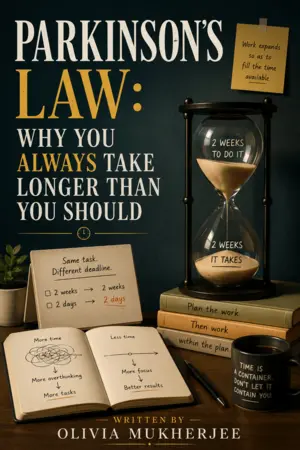
Parkinson’s Law: Why You Always Take Longer Than You Should
Non-Fiction
May 4, 2026
By olivia.mukherjee1986
Somewhere on your desk, or in your browser tabs, or in the back of your mind, there is a task that should have taken two hours. It has now been three days. You have touched it, left it, returned to it, revised the parts that did not need revising, and somehow it is still not finished. You are not lazy. You are not disorganized. You are simply obeying a law you probably never knew existed.
In 1955, a British naval historian named C. Northcote Parkinson published an essay in The Economist that began as satire about government bureaucracy. He had noticed something odd about the British Civil Service: the number of administrators kept growing even when the actual amount of work did not. Officials were generating more meetings, more memos, more committees, not because the workload demanded it, but because the structure allowed it. More time and more people created more work to fill both. He distilled this observation into a single sentence that has since outlived every bureaucracy he was mocking: work expands to fill the time available for its completion.
What he meant as a joke about government turned out to be an uncomfortably accurate description of how all of us operate, every single day.
The Uncomfortable Experiment You Can Run Right Now
Here is a thought experiment that will probably feel familiar. You need to write a report. If your deadline is one week away, you will spend a day or two thinking about the approach, another day gathering information you may not use, some time drafting, more time second-guessing the draft, and a final stretch polishing things that were fine two edits ago. If your deadline is two hours away, you will open the document, decide what needs to be said, write it, check it once, and send it. The output will be roughly the same quality. The time investment will be radically different.
Same task. Same person. Same brain. Completely different behavior.
The variable that changed was not your capability or your effort or your intelligence. It was the container. And the container shaped everything that went inside it.
What Your Brain Is Actually Optimizing For
The reason this happens is that your brain is not, by default, optimizing for efficiency. It is optimizing for comfort. When time is abundant, the brain interprets that abundance as permission: permission to delay starting because there is no urgency, permission to overthink decisions because there is room for uncertainty, permission to chase perfection because there is still time to keep going.
None of this feels like wasted time while it is happening. It feels like diligence. It feels like thoroughness. You are being careful, being responsible, making sure you get it right. But a significant portion of what you are calling careful preparation is just expansion. The task is getting bigger not because it needs to be bigger, but because the time you gave it allows it to grow.
Psychologists studying procrastination and time perception have found that humans are remarkably poor at distinguishing between effort that produces results and effort that produces the feeling of results. When we spend a long time on something, it registers in the brain as important work, which in turn makes us feel productive, which in turn makes it easier to keep going without noticing that the return on that effort dropped off sometime around hour two.
The Deadline Is Not Your Enemy
Everyone has experienced the deadline effect, that strange transformation that happens when time genuinely runs out. You have been circling a project for days. Then suddenly you have two hours, and something shifts. You become focused in a way you have not been all week. You stop second-guessing, stop reopening decisions you already made, stop adding things that were not on the original list. You finish. And it is good. Often it is better than the version you would have produced if you had kept tinkering.
The deadline did not improve your abilities. It removed the noise. The overthinking, the perfectionism, the endless revision loop: all of it dissolved because the constraint made it impossible. Urgency forced honesty. You could only work with what actually mattered, because there was no time left for anything else.
This is the part that tends to make people uncomfortable when they first sit with it. If your best, most decisive work tends to emerge under pressure, what exactly have you been doing with all that extra time?
The Three Hidden Ways Expansion Shows Up
Parkinson's Law is most visible in deadline crunches, but it operates quietly in subtler ways throughout every working day.
The first is artificial complexity. A task that is genuinely simple gets surrounded with scaffolding it does not need. You research before you start, then research again after you draft, then question whether your sources were the right sources. You create a planning document for a task that did not require a plan. The work grows not because the problem is hard but because the time budget invites elaboration.
The second is decision cycling. When you have time, you reopen decisions you have already made. You revisit the structure you settled on yesterday. You wonder if the approach you chose last week was really the best one. This is not reflection or quality control. It is expansion wearing the costume of due diligence. The decision was made. The time you still have is persuading you it was not.
The third is what researchers sometimes call effort justification: the tendency to value something more if you spent a lot of time on it. When a task takes a long time, it starts to feel weighty and important, which creates a subconscious incentive to keep treating it as weighty and important, which keeps you spending time on it. The task did not earn its status. You assigned it status by pouring time into it, and then the status made you pour more.
The Counterintuitive Prescription
The standard advice for productivity is to find more time: wake up earlier, batch your tasks, protect your mornings, build longer focus blocks. All of that can be useful. But Parkinson's Law points at something the more-time prescription completely misses. More time, given to a brain that expands work to fill whatever container it is handed, is not always a gift. Sometimes it is just a larger container.
The more counterintuitive move is to shrink the container deliberately. Not to rush, not to produce sloppy work, but to set a boundary that is honest about what the task actually requires rather than what your anxiety or perfectionism would like to give it.
If you usually allow yourself a full morning to write something, try allocating ninety minutes and treating it as a hard stop. If you normally schedule hour-long meetings, run one at forty minutes and see how much the conversation actually needed the other twenty. If you have been living with a task in your to-do list for two weeks with no deadline, give it one. Not a gentle guideline. An actual constraint.
What tends to happen is not that the quality drops. What tends to happen is that you discover the task was never as large as the time you had been giving it.
The 80/20 Reality That Nobody Wants to Look At
There is a pattern in almost every creative or analytical task that takes longer than it should. The first portion of the effort, maybe twenty or thirty percent of the total time, produces almost everything of value: the core argument, the key decisions, the substance that actually matters. The remaining time produces refinements and adjustments that are, when evaluated honestly, close to invisible in the final result.
Parkinson's Law is most expensive in that second zone. It is not that the extra effort is harmful. It is that it is largely indistinguishable from the version you had before it. You cannot feel the difference between the piece you would have submitted at the two-hour mark and the piece you submitted at the five-hour mark. But your calendar absolutely can.
This is not an argument against doing good work. It is an argument for being honest about when good work became compulsive refinement, and what that distinction is actually costing you across a week, a month, a career.
What Changes When You Understand This
The practical shift is not dramatic. You do not need a new system or a new app or a new morning routine. You need to change one question.
Most people approach a task by asking how long it will take. That question hands control to the task. It invites the task to set its own container, and a task with an open container will always fill it. The better question is how much time you are willing to give this. That question puts you back in charge. You are no longer discovering the size of the work. You are deciding it.
That one shift in framing changes everything that follows: how you start, how you prioritize, when you stop, how you evaluate what done actually means.
The Real Thing Parkinson Was Describing
What Parkinson noticed in the Civil Service was not really about bureaucracy. It was about human nature in the presence of abundance. When resources are plentiful, whether the resource is money or staff or time, systems naturally find ways to use all of it. Not out of malice or laziness. Out of expansion as a default mode.
You are not immune to this. Neither is anyone else. The question is simply whether you are running the expansion, or whether the expansion is running you.
Time is not just a resource you spend. It is a signal you send to your own brain about how much this matters and how hard you need to work. Send the wrong signal long enough, and tasks that should take an hour start taking a day, and days that should produce real results start producing the sensation of busyness without the substance of progress.
The container shapes what goes in it. You get to choose the container.
Choose it smaller than feels comfortable, and see what happens.