
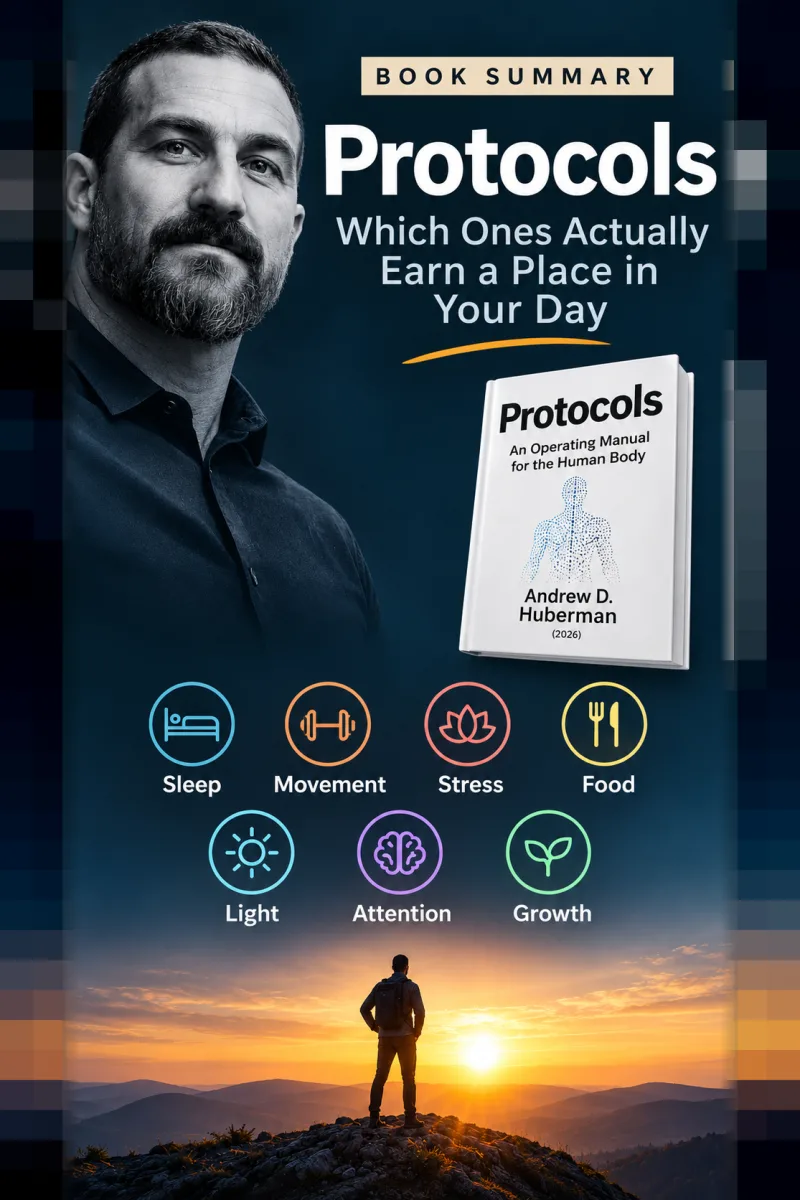
Protocols by Andrew Huberman — Which Ones Actually Earn a Place in Your Day
Book Summaries
November 1, 2026
By NPOWS New
Andrew Huberman's book is built on one idea: your body runs on a small number of systems, sleep, light, movement, stress, food, and attention, and each one has a handful of levers you can pull on purpose. Most people pull them by accident, if at all. The book turns those levers into numbered steps, which he calls protocols, with the reasoning behind each one and the questions people usually ask next.
The order of the book is the advice. Sleep comes first because everything else gets easier when it's fixed. Then exercise, then stress, then food, then light, then focus and learning, and finally a chapter on personal growth. Supplements show up throughout, but always ranked below the behavior. Fix the behavior first, then decide whether you still need the pill.
Sleep starts in the morning
The most repeated instruction in the book is also the simplest: get outside within the first hour of waking and let daylight hit your eyes. Five to ten minutes on a clear day, longer when it's overcast. No sunglasses, and a window doesn't count. That morning light sets the body's clock, and the clock decides when you'll feel sleepy that night. A late-afternoon dose of daylight helps too, because it makes your eyes less sensitive to indoor light later.
The night side is the mirror image. Dim the lights in the last hour before bed, keep screens out of it, and keep the bedroom cool, with the book suggesting somewhere around 18 to 20°C as a comfortable range. A warm shower before bed helps, because your core temperature drops afterward and that drop is a signal to sleep. This one has decent research behind it. On caffeine, the book takes a conservative line: stop 8 to 12 hours before bedtime, since how fast people clear caffeine varies a lot, and push your first coffee to an hour or so after waking. Naps stay short, around 15 to 20 minutes, unless you're deliberately using a longer one.
The goal isn't perfect sleep every night. It's good sleep on most nights, and a routine sturdy enough that one bad night doesn't turn into a bad week.
A weekly exercise template, not a workout
Exercise is laid out as a weekly structure, and it's the book's ideal template rather than a minimum everyone has to hit. Three resistance sessions of about an hour, with sets taken close to failure and the load creeping up over time. Three kinds of cardio: one long, easy session of 45 to 75 minutes at a pace where you can still breathe through your nose, one moderate session of 25 to 30 minutes, and one short, hard interval session. Mobility work two to four times a week. And walking, especially a short 5 to 10 minute walk after meals, which reliably blunts the blood sugar spike that follows eating.
Turning stress down, then raising your ceiling
The stress chapter separates two problems. One is calming down right now. The other is becoming harder to rattle in the first place.
For right now, the tool is the physiological sigh: two inhales through the nose, the second one topping up the first, then a long, slow exhale through the mouth. The book uses one to three of these as a quick reset in the moment, and five minutes a day of the same pattern as a daily practice.
For raising your ceiling, the book uses deliberate discomfort. Cold water is the main example: one to three minutes, a few times a week, adding up to around 11 minutes weekly. Huberman measures the dose in moments when you badly want to get out and stay in anyway, because learning to stay calm while your body is yelling at you is the actual training. One detail people miss: he suggests keeping cold plunges about six hours away from strength training, because cold straight after lifting can interfere with muscle gains.
The book also leans on NSDR, "non-sleep deep rest," a guided yoga nidra style practice of 10 to 20 minutes, as a midday reset and as a way to get back to sleep after waking at night.
Food without a named diet
The nutrition chapter refuses to pick a tribe. No keto, no vegan, no carnivore. Instead there's a hierarchy. The book's own target is that roughly 90 percent of what you eat should be unprocessed or close to it. Every meal starts from a protein source. Fibrous vegetables and fruit carry most of the carbohydrates. Stop eating two to three hours before bed. And on intermittent fasting, the book is refreshingly blunt: for weight loss, it mostly works by making you eat less. When calories are matched, studies generally don't show a major weight advantage, though fasting may have other metabolic effects that are still being studied.
Light as a tool, not just for sleep
Beyond morning and evening, the light chapter covers sunlight on the skin and red or near-infrared light in sessions of 10 to 30 minutes. Treat that last one as promising rather than proven. Results depend heavily on the wavelength, the intensity, how long you're exposed, and what you're trying to treat, so it isn't a general-purpose health fix. The chapter also points out that the light in your house at night matters more than most people think. How bright it is, how blue it is, and how long you sit under it all affect melatonin, which is why dim, warm light in the evening is the safer default.
How learning actually sticks
This chapter is the most useful one for students and anyone picking up a new skill. Learning, in this model, is a cycle. Get alert first, through sleep, water, food, and getting your phone out of the room entirely. Some research suggests a phone within reach drains attention even when you don't touch it, though later studies have struggled to reproduce that effect. It's still an easy habit with little downside. Create urgency, using a simple planning method called WOOP: wish, outcome, obstacles, plan, with an if-then for each obstacle. Then treat mistakes as the signal that tells the brain to change, not as proof you're failing.
Two small tactics stand out. During practice, take random pauses of about ten seconds, which the book says help the brain replay what you just did. And test yourself instead of rereading, since highlighting and rereading feel productive but do very little on their own. Then protect your sleep that night, because that's when much of the rewiring happens.
The softer chapter
The book ends on personal growth. It borrows from the psychologist James Hollis: use a short ritual, even a few breaths, to switch between the roles you play during a day, and spend regular time alone without a device. It recommends expressive writing, 15 to 30 minutes about something difficult, four days in a row, with the warning that you'll often feel worse before you feel better. And it treats grief as the brain still expecting someone who isn't coming back, which is why small rituals, a candle, a photo, a letter, help it update.
The one thing it gets wrong: one size for everyone
Most of this book holds up well. Its real weakness is that it writes one daily schedule and hands it to everyone, as if we all wake at the same hour, work in daylight, and live under the same sky. We don't, and the protocols bend more than the book admits.
Take the morning. The book is built around an early riser: up with the sun, outside within the hour, caffeine a little later, lights down early. But body clocks genuinely differ. Some people are naturally late types, and they think, create, and work at their best late in the day. Forcing them onto an early schedule doesn't make them healthier. It leaves them permanently short on sleep, a mismatch researchers call social jet lag. If you sleep late, wake late, and do your best work at night, you don't have a problem to fix. Keep the principle, light soon after you wake and darkness before you sleep, and let your clock decide when that is.
Then there are people who barely see daylight at all: night-shift nurses, call-centre staff, security guards, anyone working while the rest of the world sleeps. "Get morning sunlight" is close to meaningless for them, and following it literally makes things worse. A night worker driving home in the morning sun is telling their body it's the start of the day, just before trying to sleep. For them the protocol runs in reverse. Bright light at the start of the shift, sunglasses on the way home, and a properly dark room to sleep in.
Other exceptions follow the same pattern. Someone whose clock already runs early can make 4 a.m. waking worse with extra morning light; they usually need light later in the day instead. Someone with long-term insomnia can find fifteen-odd sleep rules become one more thing to fail at; the best-proven treatment, CBT-I, actually has you spend less time in bed for a while. And the setting matters too. A "cold shower" in a hot country isn't the near-freezing water the book means, and a northern winter can leave you no sunrise to step out into before work.
None of this makes the protocols wrong. It means they're a starting point you fit to your own clock, job, and surroundings, not a timetable to obey. The book doesn't always say which of its rules are firmly proven and which are educated guesses, so try each one for a couple of weeks and keep what actually works for you.
So is it worth reading?
Yes. It's a good book, and one of the most useful health books of the last few years. The sleep, exercise, and learning chapters are the clearest plain-language version of this material you'll find, and almost every protocol has a free version you can start this week. Morning light, a walk after lunch, a couple of strength sessions a week, your phone in another room while you study.
The most useful idea in it may not be any single protocol but the order behind them: fix sleep, movement, food, and daily habits before you spend money on supplements and optimisation tools.
Just don't treat it as a checklist. Nobody needs to run every protocol at once. Read it, pick the two or three that fix your actual problem, and shape them around your own day rather than the book's. Do that, and this book will give you more practical value than almost anything else on the shelf.