
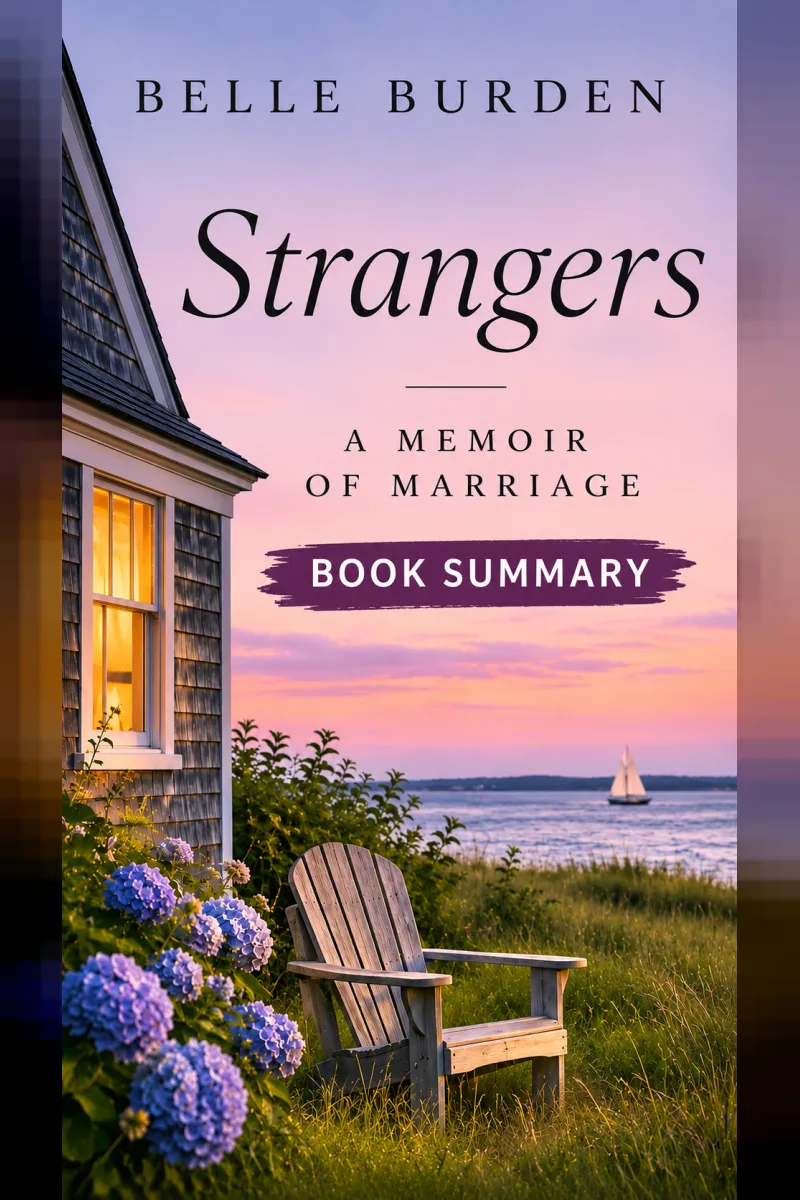
Strangers: A Memoir of Marriage by Belle Burden — When the Person You Married Turns Out to Be Someone Else
Book Summaries
November 11, 2026
By NPOWS New
In March 2020, as the world shut down, Belle Burden was at her family's house on Martha's Vineyard with her husband of almost twenty years and their family. Then, with little warning and almost no explanation, her husband James told her he was leaving. He didn't want the houses. He didn't want to talk it through. He simply went.
Strangers is Burden's attempt to understand what happened. It began as a 2023 essay for the New York Times "Modern Love" column, titled "Was I Married to a Stranger?", which spread widely online. The book, published by The Dial Press on 13 January 2026, expands that essay into a full memoir of a marriage, and it has been one of the most talked-about non-fiction books of the year.
The marriage she thought she had
Burden met James at work, when she was a young lawyer and he was beginning a career in investment management. Over the years his career grew, and he worked more and was home less. After their son was born, she stepped back from paid legal work to raise their family, doing pro bono immigration cases on the side. She describes writing as her first dream, and this book is, in part, a return to it.
For most of the marriage, by her account, things looked solid. That is what makes the ending so disorienting. Soon after, a message from a stranger revealed that James was having an affair. The rest of the book is a slow, careful search through two decades of memories for the moments she now sees differently.
It's worth remembering that this is her account. James doesn't tell his side here, and the book is Burden's memory and interpretation of a shared life, not a neutral record of it.
Reading a marriage backwards
The book's real subject is hindsight. Burden goes back to the courtship, the wedding and the long, ordinary years in between, looking for clues. Some are obvious to the reader long before they were to her. Others only make sense once you know how the story ends.
This is what gives the memoir its unsettling power. Most of us assume we know the people we live with. Burden shows how easy it is to build a life on trust, and how hard it is, after that trust breaks, to tell which memories were real. Her recurring image of ospreys, birds that leave each year and return to the same nest, becomes a quiet way of thinking about what she believed a marriage was.
Privilege, money and the question of control
Burden comes from old, inherited wealth: summer houses on the Vineyard, private schools, country clubs. She doesn't hide it, and some readers will find it hard to look past. Sarah Rachel Egelman, reviewing for Bookreporter on 16 January 2026, noted that her circumstances are very different from most readers' experience of divorce.
But the book makes a sharper point than "even the rich suffer". Like many women who leave work to raise children, Burden handed over much of the financial control in her marriage. Kayla Kramer, writing in The Commentator on 28 April 2026, admitted she wanted to warn Burden as she read, and many readers will feel the same. Money didn't protect her. If anything, the book shows how wealth can hide the same imbalances of power found in ordinary marriages.
Why readers can't put it down
What most reviewers praise is her tone. Burden writes with control rather than fury. She doesn't ask for sympathy, doesn't caricature James and doesn't pretend to have all the answers. Egelman called her writing candid and sincere, and Kramer argued that the book's real draw is its vulnerability, not the drama of the breakup.
That restraint is a deliberate choice, and it is what makes the book feel trustworthy. You come away angry on her behalf precisely because she so rarely tells you to be.
What it doesn't give you
Readers hoping for a full explanation won't get one. By the end, James's reasons remain largely unclear, because they were never fully explained to Burden either. Some will find that frustrating. Others will see it as the honest point of the book: sometimes the person who leaves never tells you why.
Divorce is also, as Egelman put it, mundane in many ways. Lawyers, logistics and long silences take up real space in the story, and the middle of the book is quieter than its dramatic opening.
Should you read it?
Strangers is a short, controlled and deeply unsettling memoir about how little we may know the people closest to us. It's at its best when Burden examines her own assumptions, and less gripping when it moves into the slower business of separation.
Read it if you have ever wondered how well you really know someone, or if you're rebuilding after a relationship ended without an explanation. It offers no neat lessons, but it offers something rarer: the honest account of a woman trying to make sense of a story whose most important chapter was hidden from her.
Questions worth sitting with
1. Which warning signs did you notice before Burden did, and do you think you would have seen them in her place?
2. How does her wealth change the story, and how much does it not change?
3. Is it fair to judge a marriage by how it ended?
4. Did you want James's side of the story, or is the book stronger without it?