
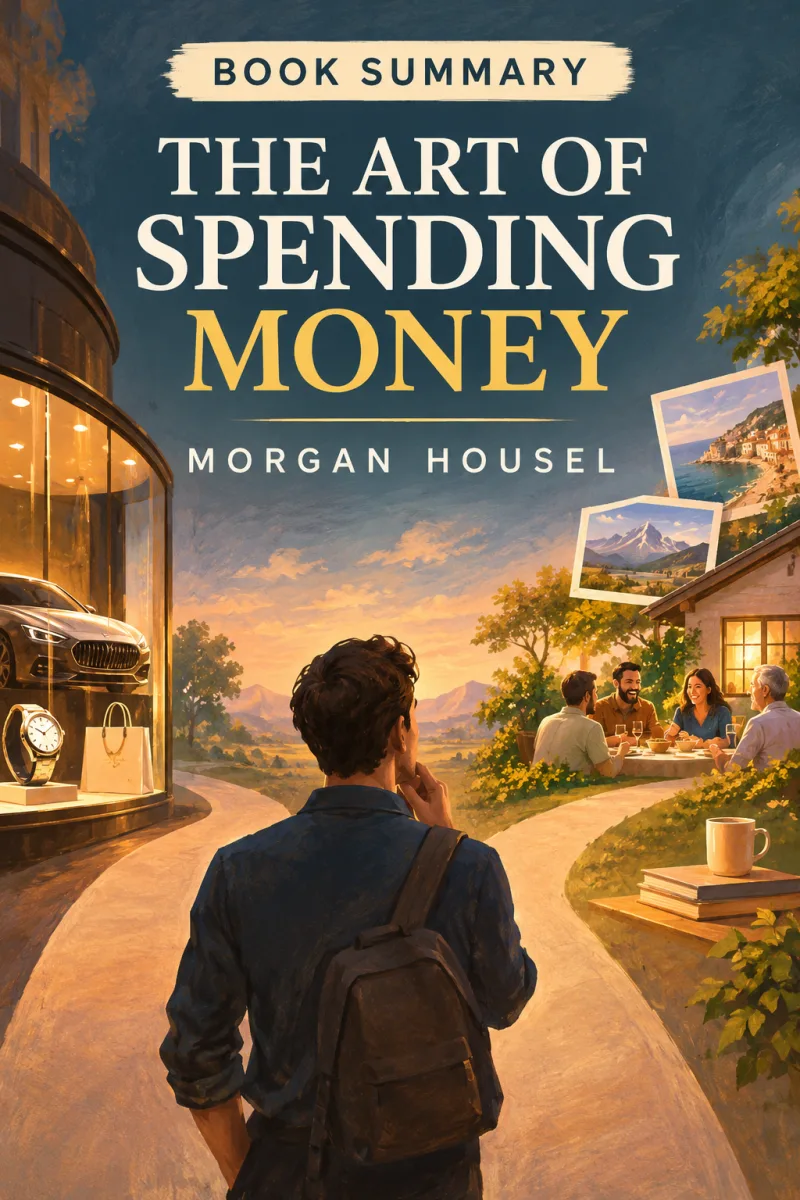
The Art of Spending Money by Morgan Housel — Why a Richer Life Is About More Than a Bigger Balance
Book Summaries
November 9, 2026
By NPOWS New
Most money advice is about the first half of the problem: how to earn more, save more and invest well. Very little of it is about the second half, which is what you actually do with the money once you have it. Morgan Housel's third book is about that second half. Spending, he argues, is not a maths problem with one right answer. It's closer to an art, because what makes a purchase worthwhile depends on who you are, what you value and what kind of life you're trying to build.
Housel is best known for The Psychology of Money, the 2020 bestseller about why behaviour matters more than intelligence when it comes to wealth, and for Same as Ever, his 2023 book about the things that never change. The Art of Spending Money was published on 7 October 2025 by Portfolio, with Harriman House publishing the UK edition. It isn't a formal sequel, but it extends the earlier book's ideas from saving and investing into spending. Readers of Housel will recognise his style: short chapters, each built around one idea, plenty of quotations from investors and writers he admires, and a steady focus on how people feel about money rather than on spreadsheets.
All spending makes sense to the person doing it
Housel opens with an idea that will be familiar to his readers. Spending choices that look strange from the outside usually make perfect sense once you know someone's history. A person who grew up with very little may struggle to spend money even when they have plenty. Someone else may spend freely precisely because they remember what it felt like to have nothing. Personal finance, as Housel puts it, is more personal than it is financial.
The practical lesson is twofold. Be slower to judge how other people spend, because you rarely see the full story. And be honest about where your own habits come from, because the experiences that shaped them may not match the life you're living now.
Attention, status and the gap between having and wanting
A large part of the book is about why we buy things. Often, Housel argues, people aren't really after the object at all. They want respect, admiration or attention, and they hope the purchase will bring it. It rarely does. Most people are far too busy thinking about themselves to notice what you own. And the small circle of people who genuinely care about you, your family and a few close friends, are rarely impressed by possessions anyway.
This leads to one of the book's central ideas: contentment depends on the gap between what you have and what you want. If your expectations rise every time your income does, you'll never feel you have enough, no matter how much you earn. Housel describes this kind of desire as a hidden debt that has to be paid off before you can feel satisfied. Lowering expectations, he suggests, often does more for happiness than raising your circumstances.
He also borrows a neat image from the publisher Tim O'Reilly: money is like petrol on a road trip. You need enough of it, and running out would be a disaster, but the point of the trip isn't to tour petrol stations.
Utility versus status
Housel draws a line between spending for utility and spending for status. Utility spending makes your own life better in ways you'd value even if nobody saw it. Status spending is aimed at other people's opinions. Social media has made the second kind far more tempting, because it turns almost everyone into a neighbour whose life you can compare with your own. The status game is almost impossible to win, Housel points out, because there's always someone further ahead.
In real life the line is blurrier than the book sometimes suggests. A wedding, a family home or a good suit for an interview can bring genuine personal joy and social recognition at the same time, and in many families, spending on shared occasions is partly about honouring other people. The more useful question isn't whether a purchase involves other people's opinions, but whether those opinions are the main reason you're making it. The same new phone can be a working tool for one person and a badge for another. What differs is the reason for buying it.
Housel's practical answer is to spend generously on the things that genuinely matter to you and cut back hard on the things that don't, a principle he credits to the personal finance writer Ramit Sethi. He contrasts the Vanderbilt family, whose enormous fortune was spent and scattered within a few generations, with Chuck Feeney, the billionaire who lived simply and gave almost all of his wealth away. Real lives are messier than any two-line comparison, but the contrast makes Housel's point: the size of a fortune says little about whether it was spent well.
Minimising future regret
Rather than choosing between "live for today" and "save for tomorrow", Housel suggests a different test: which choice will you regret least later? He imagines looking back from the end of his own life. For him, leaving his family exposed through overspending would be a bigger regret than having skipped some expensive dinners. Other people will reach different answers. Some will most regret experiences they didn't have while they were healthy enough to enjoy them. Most people will end up somewhere in between.
He adds that good memories compound too. An experience shared with people you love keeps paying out for years in a way that most possessions don't.
Independence, again
Housel's argument that the highest return on money is independence will be familiar from The Psychology of Money. Here, though, the repetition does real work. In the earlier book, independence was a reason to save. In this one, it becomes a way to judge spending: money you save isn't wasted just because you haven't spent it, because it buys options, time and less stress, which can be worth as much today as any purchase. Spending that frees up time or removes a recurring source of stress often counts for more than spending that adds another possession.
Independence means different things to different people, though, and this is where the book is at its most individual. For a single professional, it may mean the freedom to leave a job. For someone supporting parents or children, it may mean never having to borrow in an emergency. The principle travels well. The particular version of freedom you're buying is yours to define.
Quiet money and loud money
Housel contrasts money spent quietly on your own life with money spent loudly as a scoreboard. Quiet spending tends to be steady and personal. Loud spending is performative, and the wealth behind it is often less solid than it looks. Someone driving an expensive car may be anxious about the payments. Wealth, he reminds readers, is largely invisible: it's the purchases you chose not to make.
He also recommends keeping your identity small, so that your sense of who you are doesn't depend on your net worth. And he encourages a spirit of experiment: within your budget, try new ways of spending, notice what genuinely improves your life, and quickly drop what doesn't.
Where the advice needs adapting
Much of the book's value lies in its refusal to give one right answer, and Housel says openly that people with different values will spend differently. Still, a few things are worth keeping in mind.
The book is written for readers who have some choice about how to spend. If most of your income goes on essentials, or you support parents, children and wider family, the question isn't which luxuries to cut but how to cover what you already need. The ideas about contentment and regret still apply, but they look different when the margins are thin.
Readers who know The Psychology of Money will also find familiar ground, and the chapters can feel loosely connected, with later ones rarely building on earlier ones.
Finally, this isn't a practical budgeting guide. It won't tell you how much to spend on housing, how to plan for a family or how to handle debt. It's a book about how to think, and you'll need more practical help to turn that thinking into a plan that fits your local costs, taxes and family responsibilities.
So is it worth reading?
Yes, especially if you liked The Psychology of Money. The Art of Spending Money is short, easy to read and full of ideas that stay with you, and it fills a real gap: very few money books take spending as seriously as saving and investing.
If you've already read Housel's earlier books, expect some overlap. If you're looking for a step-by-step budget, look elsewhere. But if you want a calmer, more honest way to think about what your money is for, this is one of the best places to start.
Most of us practise earning money every working day. Knowing what to do with it is a different skill, and one that almost nobody teaches. This book is a good place to start learning it.