
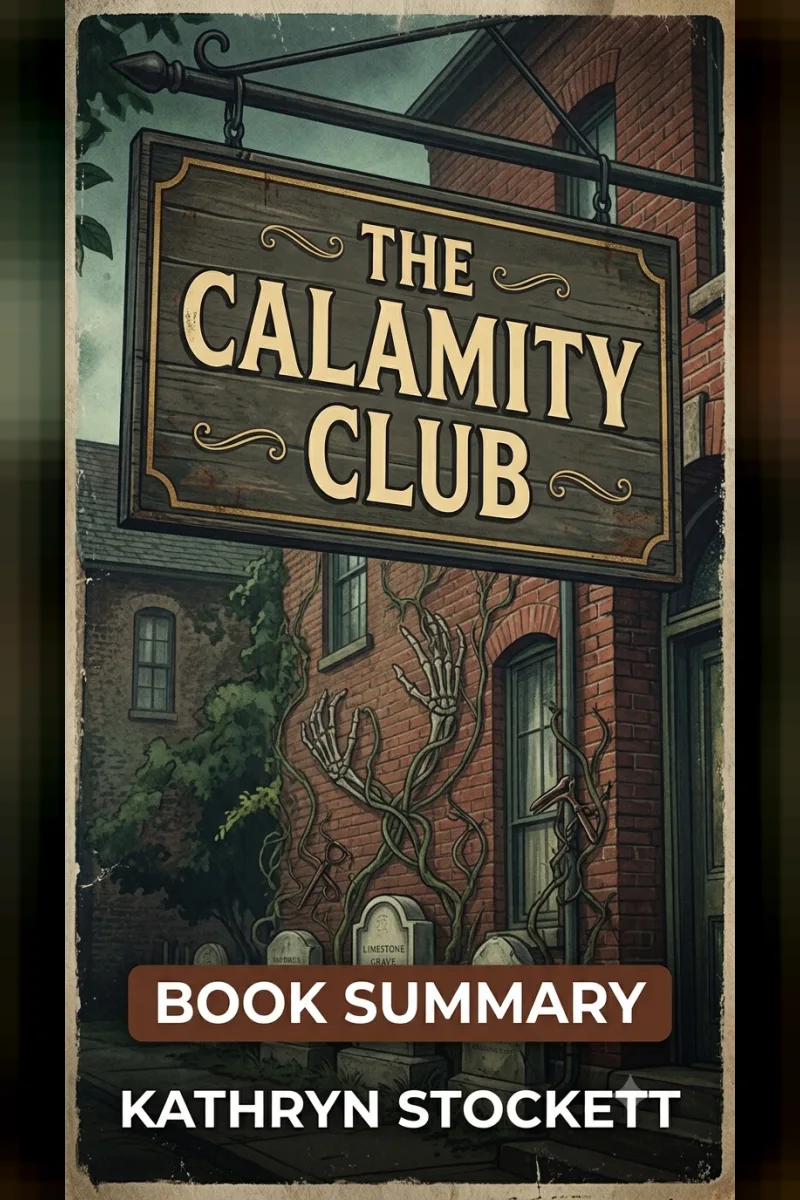
The Calamity Club by Kathryn Stockett — Three Women, One Orphanage and the Hard Summer of 1933
Book Summaries
November 10, 2026
By NPOWS New
Seventeen years after The Help, Kathryn Stockett has gone back to Mississippi. Her first novel, published in 2009, became a worldwide bestseller and a hit 2011 film. Her second, The Calamity Club, published by Spiegel & Grau on 5 May 2026, moves the clock back three decades to 1933, when the Great Depression had emptied pockets across the American South and a woman's future could depend on one signature from a man, a board or a judge.
It's a big book, 656 pages in hardcover, and a busy one. It is also darker than its slightly playful title suggests.
Meg, waiting
Meg Lefleur is eleven and lives at the Lafayette County Orphan Asylum for Girls in Oxford, Mississippi. She isn't really an orphan. Her mother, Charlie, left her there one Christmas Eve, and Meg has been waiting for her ever since. Now she is one of the "big girls", trusted with office work and old enough to understand what may come next: girls who reach twelve without a family can be sent away to work, and Meg is close to that age. The asylum's chairwoman, Garnett Pittman, has taken against her, and the summer brings punishments that become genuinely cruel.
Stockett gives Meg a quick, stubborn and often comic voice, and sets her speech in italics rather than quotation marks. The effect is intimate, as if we are hearing her thoughts before anyone else does.
Birdie, refusing to be grateful
The other narrator, in alternating chapters, is Birdie Calhoun, twenty-four, unmarried and a bookkeeper who is better at her job than most of the men around her and paid less than the man who sweeps the floor. Back taxes threaten the family home in the Delta, so Birdie travels to Oxford to ask her sister Frances for money.
Frances has done everything a woman of her class was supposed to do. She married Rory Tartt, a wealthy man, and lives what looks like a charmed life in Oxford society. But she has also cut herself off from her family, and Birdie quickly sees that the Tartt household is under more strain than its parties suggest. Through Frances, Birdie ends up keeping the orphanage's books, which is how she meets Meg.
Charlie, with a plan
The third woman at the centre of the story is Charlie, Meg's mother. She doesn't narrate, but she drives much of the plot. Down on her luck and short of options, she returns to Oxford to find her daughter, carrying a bold scheme to change her fortunes. Birdie promises to help, and from there the three women's lives become tied together in ways that put all of them at risk. Publishers Weekly described the novel as being about these three intersecting lives, and that is the best way to understand it.
The history underneath
What gives the book its weight is the real history behind it. In the author's note, Stockett discusses Mississippi's 1928 sterilisation law, which allowed state institutions to sterilise people classed as "feeble-minded" or mentally ill. According to research compiled by the University of Vermont sociologist Lutz Kaelber, 683 sterilisations were recorded under the law, 523 of them of women, and the practice continued until 1963.
That history explains the novel's sense of threat. In Meg's world, being poor, female and without a family meant that other people could decide almost everything about your future. Seen this way, the book's real subject is power: who has it, who doesn't, and the improvised, sometimes illegal ways women without it found to protect themselves and each other. Birdie's low wages, Frances's dependence on her husband's money and Charlie's desperation are different versions of the same problem.
How it reads
Most critics agree the book is hard to put down. Kirkus called it a compulsively readable, twisty yarn and suggested it would make a good television miniseries. Publishers Weekly found it "by turns hilarious and heartbreaking". Pamela Kramer at Bookreporter took a less comic view, arguing that the book's picture of how women were treated "should make you angry".
The criticisms are mostly about excess. Kirkus found the plot overstuffed, with enough developments for several novels, and felt the many threads were tied up too hastily. It also found Garnett Pittman one-dimensional, a villain without any complexity. Publishers Weekly noted that the pace sags in places.
Readers of The Help may also bring its history with them. That novel was praised for its storytelling and criticised for how a white author voiced Black characters. Kirkus's reviewer observed that this time the central characters are mostly white women, and suggested that may be a response to that debate. Readers will judge for themselves whether the new book handles race in 1930s Mississippi any better by keeping it largely in the background.
Our verdict
The Calamity Club is a page-turner built on serious history. Its strengths are its narrators, its sense of place, and its anger at how easily women's lives could be controlled. Its weaknesses are a plot that keeps adding complications and a villain who is never more than cruel.
It's a strong choice if you like long historical novels and enjoyed The Help. If you prefer tight, restrained fiction, its size and its many twists may wear you down.
Questions for book clubs
1. Meg and Birdie narrate, but Charlie drives the plot. Why do you think Stockett never lets Charlie tell her own story?
2. Is Frances a victim of her world, someone who benefits from it, or both?
3. Which of the women's choices did you admire, and which did you find hard to accept?
4. How did the author's note about the 1928 law change the way you read the orphanage chapters?
5. Birdie is paid less than a man who sweeps floors. Which parts of the book's picture of women's work still feel familiar?
6. If you have read The Help, how do the two books compare in whose stories they choose to tell?