
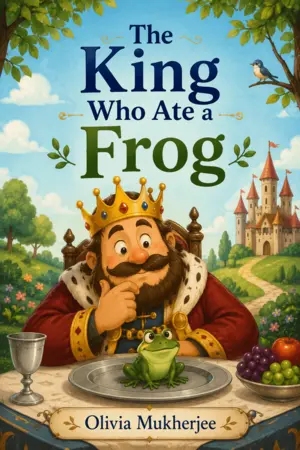
The King Who Ate a Frog
Fantasy
May 10, 2026
By olivia.mukherjee1986
Queen Mrinalini understood something her husband did not: power borrowed from fear behaves like a borrowed horse. It runs beautifully; until the day it throws you into a ditch and walks off without looking back.
Her father, Maharaj Devkant, had built Veerendra's kingdom from the ground up; his armies, his gold, his alliances arriving at precisely the right moment. Veerendra had stopped mentioning this approximately two years ago. Success makes many men rewrite history in their own favour. Kings do it with particular confidence, having no one to correct them.
Three years after the conquest of Radhashila, King Veerendra believed there was nothing left in the world capable of surprising him.
His armies had crossed deserts. His banners flew over seven provinces. His treasury overflowed with gold that the king held as a monument to success.
He ruled through fear, which he preferred to all other methods. Fear was efficient. Fear didn't ask for festivals. Fear didn't take holidays.
One afternoon, in the breathless stillness before monsoon rain, they argued in the palace garden.
"You speak to me," Veerendra snapped, "as though this kingdom would not stand without your father."
"It would not have stood without him," the queen said simply.
Pride can survive mockery. It cannot survive calm truth. The king's face darkened like a sky deciding to storm.
"You live in silk because of me."
"No. You live like a king because my father allowed it."
Above them, unnoticed in the banyan branches, a green parrot sat eating guava with an expression of deep personal satisfaction.
He had been listening.
He had opinions.
He tilted his emerald head. Then, just as Veerendra turned away furiously, the parrot spoke.
"Whatever you have today, tomorrow I shall have more. Your gold is merely yellow stone. My guava? That's a score."
Silence fell across the garden.
"A bird," said the king, in a voice of dangerous quiet, "dares compare itself to me?"
The parrot puffed his feathers. "Not just any bird. One with significantly better real estate instincts."
Veerendra exploded. The parrot departed, laughing; which was the most irritating sound any living creature had ever dared to produce before him .
The soldiers searched for three days and found nothing. Birds, they discovered, are impossible to interrogate. Finally, an old hunter advised: don't search for the nest. Wait for the bird. All creatures eventually return to their nests. Follow him.
On the fourth day they followed the parrot to a ruined watchtower, where his nest contained twigs, bright stones, half-eaten fruit, and several stolen golden toothpicks from the royal palace.
The court laughed when they heard. Even the king smiled, ”Toothpicks, really?”
Then: "Catch the bird. I shall eat him myself."
The ministers exchanged glances with the practiced speed of men who communicate entirely through eyebrows. Wanting to personally consume a talking parrot is, by general consensus, a warning sign.
The parrot was captured the next morning stealing sweet rice from the temple kitchens. He considered this deeply unfair, as the rice had looked lonely.
The king was busy that afternoon, but he ensured he instructed the queen to prepare the bird for supper.
Queen Mrinalini sat beside the golden cage, studying the parrot. The parrot studied her back.
"This," he said finally, "feels unfortunate for both of us."
"You mocked the king."
"I composed a verse. Whether it also mocked the king was, I felt, a matter of interpretation."
She laughed despite herself. The parrot noted this with great interest. Openings, he thought.
"You are far kinder than your husband," he observed. "And considerably sweeter, if I may say; I also know you are wise."
"You're flattering me."
"No, just the truth" Then, lowering his voice:
"A cage of gold is still a cage; a queen deserves a wider stage... "
Against her better judgment; which is how most interesting things enter human life; the queen unlatched the cage door. Just slightly. Just to pet him.
The parrot exploded upward, ricocheted off the ceiling, knocked over a vase of marigolds, and shot through the window like something fired from a siege weapon.
"MAGNIFICENT AUDIENCE!" he shouted, already airborne. "TEN OUT OF TEN!"
Then he was gone. Into the grey monsoon sky. Leaving behind one open cage, scattered marigold petals, and one queen staring at all of it in the silence of someone who knows exactly what comes next.
At that precise moment, a large frog hopped in front of the kitchen door.
The queen looked at the frog. The frog blinked, which is the only expression available to frogs. The queen picked up the frog and said, “Maybe...”
That evening, King Veerendra ate his supper with evident satisfaction.
"Excellent bird," he declared. "Gamier than expected, but tender."
"Yes," said the queen.
Then from the window:
"O mighty king of gold and throne, who feared no man nor beast nor bone ; how was the frog? Enjoy your stone?"
The king set down his spoon. He looked at his plate. He looked at the queen. He looked at the parrot on the window rail, rain-soaked and radiantly smug.
"A frog," said the parrot helpfully, "which I personally watched cross your kitchen floor three hours ago. Lovely animal. Extremely birdlike in every respect?"
The hall was absolutely silent.
Now a wise king would have laughed. Would have said she outwitted me, the woman is extraordinary, and the story would have ended warmly and been forgotten immediately for having no ending worth remembering.
Veerendra was not, at this moment, wise.
He stood. He said things that could not be unsaid.
The queen left. Calmly. Without luggage. Without a backwards glance.
She sent word to her father: I am coming home.
Devkant roared: How dare he! I will bring my army to his door.
Fear, as the queen had always known, is a borrowed horse.
Within ten days, Devkant's forces arrived. The cities that had obeyed out of fear discovered that fear and loyalty are different things entirely. Loyalty stays when things become difficult. Fear simply finds better arrangements.
The palace guards opened the gates. It was not a difficult decision.
Veerendra fled to the highest tower and stood among his treasures; listening to a kingdom reorganize itself without him.
The parrot sat in the railing, feathers flat, looking considerably less triumphant than expected.
"I came for comedy, stayed for the fall, but no jester laughs at the end of it all. The frog was funny. The rest, not so much. A kingdom for pride is too heavy a clutch. "
Veerendra looked at the bird for a long time. Then he left it where it was and walked downstairs to his fate.