
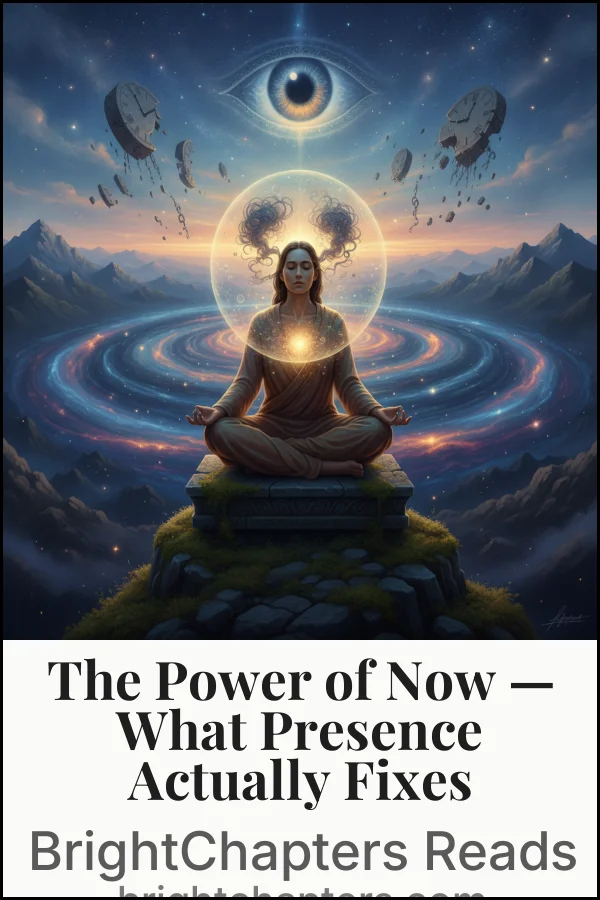
The Power of Now — What Presence Actually Fixes
July 26, 2026
By NPOWS New
Eckhart Tolle's whole book rests on one claim. You are not your mind. Most people think their thoughts are them. Tolle says that's the mistake. The thinking never stops. It just runs in the background, narrating everything, and most people never question the narrator. That's the problem he's trying to solve.
The voice in your head isn't you -
Tolle calls this constant mental noise the mind. Not intelligence. Not the brain itself. Just the nonstop commentary track: replaying old arguments, rehearsing future ones, judging what just happened five seconds ago. He says most people are so fused with this voice that they think it is them. They don't notice the thinking. They just live inside it.
His fix sounds almost too simple. Notice the thinking as it happens. Watch it instead of being it. The moment you notice a thought, Tolle says, you've created a small gap. In that gap, you're not the thought anymore. You're the one watching it. That gap is what he means by presence.
Underneath all of this sits what Tolle calls the ego. Not confidence, not arrogance. He means the identity you build out of your thoughts, your memories, your roles, and whatever you own or achieve. Presence doesn't destroy the ego, he says. It just loosens your grip on it, one noticed thought at a time.
He calls the accumulated version of old emotional pain the pain-body. Tolle treats it as a real psychological and energetic pattern, not just a metaphor. Old hurt, unresolved and unfelt at the time, doesn't just disappear. It sits there. Then something in the present pokes it. An argument, a tone of voice, a memory. The old pain floods back like it's happening right now. Tolle says most people mistake this flood for a reaction to the present moment. It's usually the past, wearing the present as a costume.
The way out, he argues, isn't to fight the pain-body or analyze it. It's to watch it. Feel the sensation in your body without the story attached to it. He says the story is what feeds it. The raw feeling, watched without judgment, tends to burn itself out.
Then there's time. Tolle splits it into two kinds. Clock time is useful, the kind you need to catch a flight or show up for work. Psychological time is different. It's regret dressed up as memory, and anxiety dressed up as planning. He says almost all suffering lives in psychological time, not in whatever is actually happening right now. Tolle's claim, not a settled fact, is that pain needs a story about the past or a fear about the future to survive. Strip either one away, and the pain has nowhere to stand.
The last big piece is surrender. Not giving up. Tolle means something closer to non-resistance: accepting what's actually happening, right now, instead of arguing with it in your head. He applies this to relationships directly. Full acceptance of the other person, exactly as they are in this moment, is what actually shifts a stuck dynamic. Fighting what already happened doesn't change what already happened. It just adds a second layer of suffering on top of the first one.
That's the whole architecture. Stop being fused with the voice in your head. Watch old pain instead of reliving it. Notice how much suffering is really just an argument with the past or a fear of the future. Accept what's in front of you instead of resisting it.
Where this echoes older ideas, and where it strains -
None of this is new, and Tolle doesn't really claim it is. The witness-versus-thought idea is old Buddhist teaching. The line between events and your reaction to them is straight out of Stoicism. What Tolle does well is strip the religious language out. He hands the same idea to a Western reader in plain, secular sentences. That's a real skill. It's also worth knowing the book leans on metaphysical claims it can't really back up. At points it suggests presence can slow aging, or change the body at a cellular level. Those claims go well past what attention and awareness can actually do. The psychological core remains compelling even without the metaphysical claims. Watch your thoughts instead of being swallowed by them.
There's a second issue, and some therapists have raised it directly. A few have said clients use "just live in the now" the wrong way. They use it to avoid processing old trauma, instead of working through it. Tolle's own answer is that presence isn't meant to bury the past. It's meant to let old pain surface, so it can be felt and released. That's a fair distinction on paper. In practice, "stop dwelling on it" and "process it fully" can look identical from the outside. A reader without guidance can easily choose the easier-sounding one.
If this is you, presence works better alongside real processing than instead of it. Therapy, or any structured way of actually working through old pain, pairs well with this book. It's a poor substitute for one.
There's a smaller but real caution worth naming too. Watching your own thoughts from a distance is safe for most people. For someone already dealing with dissociation, this is worth extra care. The same is true for anyone whose sense of what's real already feels unstable. Deliberately practicing "I am not my thoughts" can add fuel to that, not less of it. If that sounds like you, talk to a professional before making it a daily practice.
The last strain point is surrender itself. One of the book's fairer critics pointed out that surrender assumes you're already close to okay. It's a lot to ask someone in the middle of a genuine crisis to simply accept what's happening. Someone actively unsafe, in real danger, still fighting for something urgent, needs more than acceptance right now. Tolle's version of acceptance works best once the immediate fire is out. It's not a first response to an emergency.
So is it worth reading?
Yes, for the core idea alone. Learning to notice your own thoughts, instead of living entirely inside them, is genuinely useful. Tolle explains it more clearly than most people who've tried. The pain-body idea is a good, usable way to catch an old wound reopening in real time.
Skip the parts that veer into biology and metaphysics, they're the weakest part of the book by a wide margin. Pair it with real trauma work if your past pain is the real thing you're solving. Don't treat that pain as a footnote. And if you're in the middle of a real crisis, save the surrender chapter for after things settle. Presence is a good long-term practice. It's not a first-aid kit.