
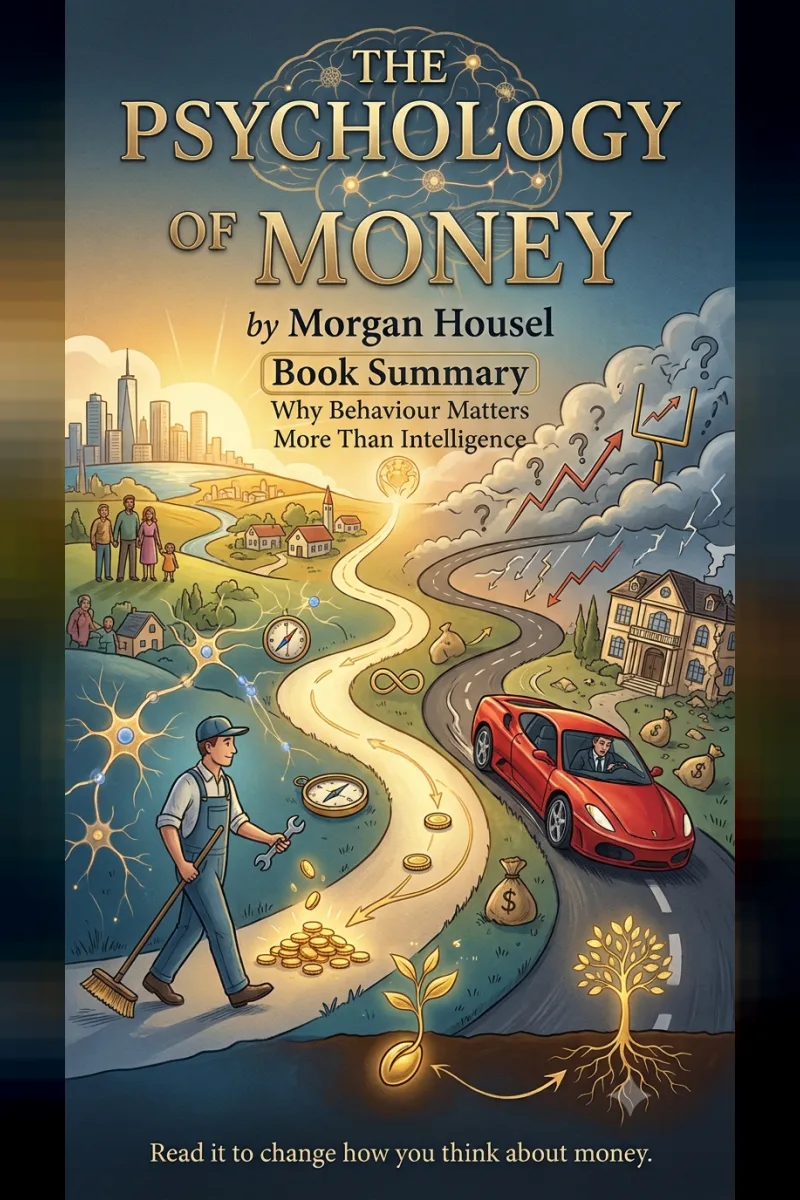
The Psychology of Money by Morgan Housel — Why Behaviour Matters More Than Intelligence
Book Summaries
November 4, 2026
By NPOWS New
Most personal finance books treat money as a maths problem. Find the right fund, the right formula, the right spreadsheet, and the rest takes care of itself. Morgan Housel's book starts from a different place. Doing well with money, he argues, has surprisingly little to do with how smart you are and a lot to do with how you behave. And behaviour is hard to teach, even to very smart people.
Housel is a former columnist at The Motley Fool and The Wall Street Journal and a partner at the venture capital firm Collaborative Fund. He developed the book from years of writing and thinking about financial behaviour, bringing together many of the ideas explored in his earlier essays. It's made up of twenty short chapters, each built around one idea and usually one memorable story. Since its release in 2020, it has become an international bestseller, selling millions of copies and appearing in dozens of language editions.
No one is crazy
The book's first idea is also its most forgiving. People make money decisions that look irrational from the outside, but almost everyone's choices make sense given their own experience. Someone who grew up during high inflation sees money differently from someone who grew up during a long stock market boom. Someone whose family lost everything in a crisis will treat risk differently from someone who has never seen a crash. Your personal history with money is a tiny slice of what has happened in the world, but it shapes your view more than anything else.
That's why, Housel says, financial behaviour varies so much between people who are equally intelligent. Before you judge someone else's choices, or your own, it helps to ask what experiences shaped them.
Luck, risk, and the stories we tell
Housel spends a lot of time on how much of financial success and failure comes down to things outside our control. His best-known example involves Bill Gates. Gates attended one of the very few high schools in the world that had a computer in the late 1960s. His close friend Kent Evans was just as talented and ambitious, but died in a mountaineering accident before finishing school. Gates got the luck; Evans got the risk. Both, Housel points out, are the same force pointing in different directions.
The lesson isn't that effort doesn't matter. It's that we should be careful about who we praise and who we look down on, and careful about copying anyone's success, because we rarely see how much of it depended on circumstances.
Enough
One of the strongest chapters is about knowing when to stop. Rajat Gupta rose from modest beginnings to run McKinsey and became extraordinarily wealthy, then went to prison for insider trading. Housel uses Gupta's story to illustrate the danger of pursuing more wealth even after achieving extraordinary financial success. The hardest financial skill, Housel argues, is getting the goalpost to stop moving. If expectations rise as fast as income, there's never a point where you feel you have enough, and that's when people take risks they never needed to take.
Compounding and staying wealthy
Compounding gets a famous treatment. Warren Buffett is a great investor, but the bigger secret, Housel says, is that he has been investing for over seven decades. By Housel's analysis, the vast majority of Buffett's wealth came after his 65th birthday. Time did most of the work. Because compounding is so unintuitive, people underestimate how much patience can achieve and keep looking for faster, riskier ways to get rich.
That leads to one of the book's key distinctions: getting wealthy and staying wealthy are different skills. Getting rich often requires taking risks and being optimistic. Staying rich requires humility, frugality, and a fear that what you've made could be taken away. The investor Jesse Livermore made a fortune shorting the market in the 1929 crash, then lost it all through overconfidence. Survival, Housel argues, is the most important part of any financial strategy, because compounding only works if you stay in the game long enough.
Wealth is what you don't see
Housel draws a sharp line between being rich and being wealthy. Rich is current income, often visible in cars and houses. Wealth is the money you didn't spend: invisible, sitting quietly, giving you options. Most people judge others' finances by what they see, which is exactly the wrong thing to measure. He contrasts Ronald Read, a petrol station attendant and janitor who quietly left an estate valued at approximately eight million dollars, with Richard Fuscone, a highly paid Wall Street executive who borrowed heavily to fund a lavish lifestyle and ended up bankrupt.
He also describes the "man in the car paradox." When you see someone driving an expensive car, you rarely think how impressive the driver is. You imagine yourself in the car. The admiration people hope to buy with expensive things often never comes.
Freedom, savings, and room for error
For Housel, the highest return money can give you is control over your time. Being able to wake up and do what you want, with whom you want, for as long as you want, is worth more than any luxury. Savings are what buy that freedom, and you don't need a specific reason to save. Saving simply gives you options and protects you from surprises.
He also argues for being reasonable rather than perfectly rational. A strategy you can stick with through bad times beats a theoretically optimal one you'll abandon when markets fall. And he wants you to leave room for error, because the future rarely turns out the way anyone predicts. The biggest risks are usually the ones nobody saw coming.
Having room for error means accepting that your forecasts will sometimes be wrong. An emergency fund, conservative assumptions and avoiding excessive debt aren't signs of pessimism. They're ways of ensuring that one unexpected event doesn't destroy everything you've built. A plan that only works when everything goes right is a fragile plan.
Where the advice needs adapting
The book's ideas are sound and widely respected, and much of its value is that it doesn't pretend there is one right answer for everyone. Housel says himself that people with different goals and circumstances will reasonably make different choices. Still, a few things are worth knowing.
The book assumes you have some money left over to save and invest. For someone living pay cheque to pay cheque, or supporting an extended family, advice to save without a goal and let time do the work describes where they'd like to be more than how to get there. The principles still apply, but the practical starting point is different.
Most of its examples and figures come from the US stock market and US financial history. The lessons about behaviour are universal, but specific numbers, like long-term market returns, depend on where you invest. Wherever you live, the practical application needs to account for local inflation, taxation, investment products, family responsibilities and access to financial services.
And it relies on stories rather than step-by-step instructions. Ronald Read is a wonderful example of patience, but a single striking story is not proof that the same approach works for everyone. If you want a detailed plan, such as how much to save, what to invest in, or how to handle debt, you'll need to pair this book with something more practical.
So is it worth reading?
Yes. The Psychology of Money is one of the most useful personal finance books of the last decade, and it deserves its reputation. Its short chapters make it easy to read, while its central argument, that how you behave with money matters more than how much you know, is relevant regardless of your income or financial background.
The book won't give you a ready-made investment strategy, and it doesn't pretend that everyone starts from the same financial position. What it offers is something more fundamental: a better way to think about money, risk, wealth and freedom.
Read it to change how you think about money. Then build a financial plan that fits your own life, rather than trying to reproduce someone else's success.