
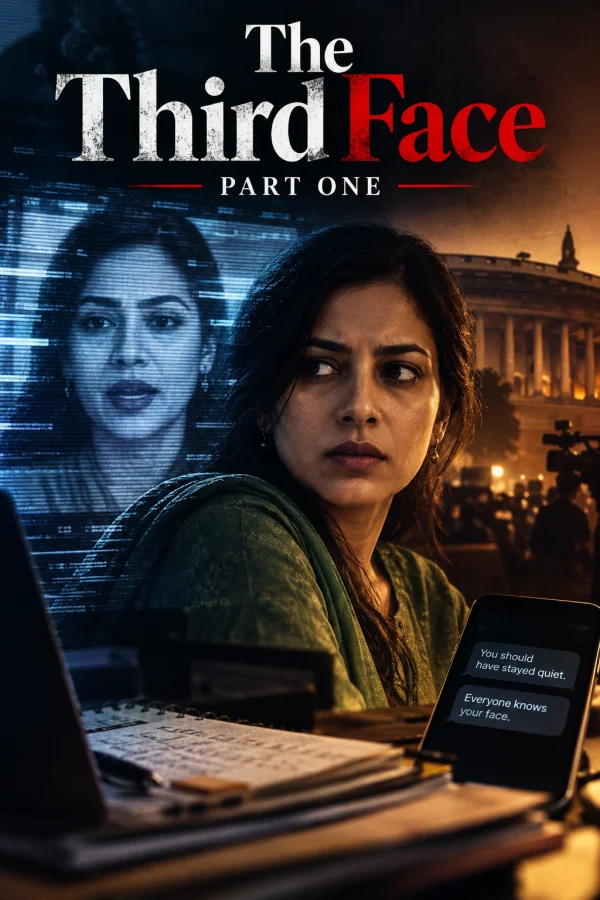
The Third Face - Part One
October 27, 2026
By Virender Jaiswal
The video had been live for forty minutes when Vasanthi Rajagopal watched herself say something she had never said.
She sat in her car outside the newsroom with her phone propped on the steering wheel. It was her face, her green cotton salwar suit, her habit of tucking her hair behind the left ear before a hard sentence. Ninety seconds long.
"Sources inside the Rashtriya Navodaya Party confirm that the party's treasurer routed campaign money through the Sri Vinayaka Charitable Trust," the other Vasanthi said. "And that the death of candidate Prakash Deshpande was not an accident."
She stopped listening after that. The other Vasanthi went on for another minute, calm and unhurried, and then the clip ended. Twenty-one lakh views.
Her phone buzzed. Unknown number: You should have stayed quiet.
Then another. Everyone knows your face.
By midnight the hashtag had a name. By two, someone had posted her home address. By three she was in a lodge on the edge of the city, registered under her cousin's name, listening to the corridor.
The worst part was that the video was right.
She had been on the Sri Vinayaka Trust for eight months and had never published a word, because she couldn't prove the Deshpande part. The trust, the treasurer, the brake failure that had been ruled an accident: it was all in a notebook in her bag, in her handwriting. Someone had taken that and put it in her mouth.
Whoever did this didn't want to embarrass her. They wanted her dead, or close to it. And they knew the story was true.
That took a while to sink in. For the first hour she couldn't think at all. She watched it with the sound off, then on, then frame by frame, looking for the join. The suit was hers. The light behind her was the window of her own study. She actually asked herself whether she had recorded this and forgotten, sitting on the edge of the bed. That scared her more than the messages. She went back through the month: every shoot, every voice note, every time she'd practised a question in the mirror. Nothing. She had never said those words to a camera.
Then how is it my voice?
She had done a segment on deepfakes once, nodding at an expert. It had felt like a story about other people. Now the other Vasanthi blinked on the screen and the blink was right, and she understood that anyone with enough footage could do this to her.
She checked the account that uploaded it. Created that morning, no name, no history, nothing to hold on to.
She put the phone face down and made herself breathe the way she did before a hostile interview. One question at a time. To make this, someone needed her footage. To say what it said, someone needed the notebook. That was a short list, and she didn't want to look at it.
She wrote three lines on a clean page. Her hand wasn't steady on the third.
Dinesh.
Smita.
Or someone else?
Dinesh Kamath was her husband for another three months, until the divorce came through. Fourteen years ago he had been her editor at a small weekly, the man who taught her to read a balance sheet. She'd reported to him once. Now he ran an independent channel with a few thousand subscribers and almost no sponsors, and he still lived in the house, in the other bedroom, because neither of them could afford to leave first.
They shared the study. Her laptop sat on the desk they'd bought together, on the days she didn't want the newsroom.
Somewhere in the last four years the numbers had flipped. Her stories got the readers and the invitations. His got sympathy. At a dinner last year someone asked him what he did and she heard him say, "I used to be her editor."
She hadn't forgotten that.
The laptop was never locked at home, because who locks a laptop in her own house? Years of raw footage sat on it, her face from every angle. Anyone making a deepfake would want exactly that.
Three weeks ago she had come down the stairs and heard him in the study on the phone with a man she'd never met, someone he called "the funding." "She's the brand," Dinesh was saying. "Brands can be replaced." He stopped when he saw her and said it was his mother.
And the Tuesday before the video, she'd noticed a login on her laptop at 2:14 in the morning. Her own account, while she was asleep upstairs. She asked him over breakfast and he said, too fast, "I needed to check my mail. Why are you auditing me?"
She hadn't pointed out that he had his own laptop. It hadn't made sense then. It did now.
Then tonight. She called him from the lodge and he picked up on the first ring and didn't ask where she was. Everyone else had asked.
Memories started coming, one after another, without her asking. The stairwell. The dinner. Dinesh at the study desk at midnight with the screen lit up, and her never wondering what he was looking at.
The last one bothered her most. The night her first big story ran, when he was still her editor, he'd picked her up off the floor of the old office, laughing, saying we did it. That was true too.
She wrote under his name: Just tired of being the furniture? Maybe. But why?
She didn't know the answer.
Smita Bhatt was the second name, and the easiest to hate.
They'd come up together and chased the same sources. Years ago, on a panel, Smita had said into the microphone, "Vasanthi's gift is that she's fearless. Mine is that I'm careful," and the audience laughed. Vasanthi went home and threw a steel tumbler at the wall.
Smita ran the investigations desk at a rival channel now, and she had been trying to get the party story for a year. For some months she had also been the favourite target of every handle that hated the party. They called her Navodaya's paid anchor. Someone kept posting photographs of her standing near the party's people at press events. Vasanthi had seen them go by on her feed and had scrolled on. It was what happened to anyone on television.
Eleven minutes after the video appeared, Smita posted a long thread. Measured, calm, calling for verification before outrage. In the fourth post was the Trust's registration date, which wasn't in the video and wasn't well known.
In March, Smita had pitched this exact story to her own editor and been turned down for lack of proof. A mutual friend had told Vasanthi, and also what Smita said afterwards in front of people: "Vasanthi doesn't need proof. She just needs the right face on camera."
Then the photograph that someone sent round that evening: Smita at a café near the party headquarters, two days before the leak, leaning across a table toward the party's spokesman. Vasanthi looked at it for a long time.
And at dawn, a reporter on the hashtag dug out that the account which first posted the video had followed exactly four people when it was created. Smita was one.
She wrote: Competitor. Motive yes. Means probably. Then, because it was four in the morning, Does she want me dead, or just off the story?
Who else? Ramanathan Iyer? But why would he? She picked up the pen and put it down again. Maybe not. She closed her eyes. She was torn.
He was executive editor of the network. He'd built the Ledger Desk around her nine years ago and given her the money and the room and, early on, something harder to get, which was somebody believing her. He came to the house when her father died and sat with her mother for two hours without saying anything clever. He still asked after her mother every other day.
When the video broke he was the first to call. He already had a lawyer on the line, a security man, and a safe house on offer that she hadn't taken. "Do the right thing," he said. "Whatever happens. I'll handle the rest." She cried on the phone and was embarrassed about it now.
But there was more...
Months back she'd shown him a draft on the Trust. He read it, took his glasses off, and said, "This is brilliant, Vasanthi. But we can't run it yet. Legal won't touch the Deshpande angle. Give it to me. Let me see what we can do with it." She said no. It was her story and she wanted to finish it. He smiled and patted her shoulder. He never asked who her sources were. She noticed that only now.
In June, at the quarterly review, Surendra Agarwal, the network's biggest investor, wanted her piece on the minister's land deal softened. He said so across the boardroom table with eleven people there. She told him, louder than she meant to, that he wasn't funding a newsroom, he was funding a PR office. Agarwal went very quiet and left before the tea came.
Ramanathan called her to his cabin that evening and looked tired. "He asked me if the Ledger Desk is worth the trouble," he said. "Do you know what it costs me to keep you? Every quarter, a new fight." Then he smiled and put his hand over hers. "Don't worry. I'll handle Agarwal."
She left lighter than she came in. Halfway down the corridor she remembered her pen, went back, and heard him through the half-open door on the phone, in a voice she didn't know. "She won't be managed. That's the problem with her." He looked up and saw her and his face changed so fast she almost doubted she'd heard it.
A few weeks later there was talk in the newsroom that Agarwal was selling his shares. Nobody said it to her.
The week before the video, Ramanathan asked to take her notebook overnight so legal could glance at the timeline. It came back the next morning with a sticky note: Excellent work. Protect this. It felt thicker when she took it back. She'd thought she was imagining that.
After the leak he told her not to go to the police yet. "It'll leak. Let me work my channels first."
She wrote, next to all of it: He's the only one who looked after me. Not likely. Then she crossed out her notes on Ramanathan.
Then, below the names, almost as an afterthought, she wrote the party and looked at it. They had the most to lose. But why would they make a video that told the world their secret? Unless someone wanted them to hunt her, and wanted it to look like she'd brought it on herself.
She wrote Agarwal? He had the power, and the rumour was that he was selling his shares. But he didn't know the notebook existed. She crossed out his name.
Dinesh, who was leaving her. Smita, who wanted her story. Ramanathan, who had never raised his voice to her in nine years. Or someone she did not know...
If she accused the wrong one she'd have ruined an innocent person on the worst night of her life. If she accused nobody she'd be dead by Friday.
At dawn she was still at the lodge's one wobbly table with a glass of tea gone cold, reading the transcript of the video for the tenth time, the way she'd read a deposition.
"...routed campaign money through the Sri Vinayaka Trust..."
"...the death of candidate Prakash Deshpande was not an accident."
All of that was public, or guessable. The Trust's name had been in a filing for months. The brake failure was in every archive.
Near the end, under the closing music, the other Vasanthi said one more line. She'd missed it the first forty times.
"...and the final transfer cleared on the ninth, through an account ending four-one-seven."
She stopped breathing.
She turned the pages of her notebook to find it. Final transfer, 9th. Acct ending 417. Her handwriting, small and cramped.
She hadn't put that number in an email, a draft, or any file on any laptop. It was on that page and in her head. And she had said it out loud exactly once, in the last week before the video, in a room with the lamp on.
In the gravel yard outside, a car door slammed. Then another. Then footsteps on the stairs, more than one person.
A few seconds later, there was a knock on the door.
A man's voice, calm and polite. "Open the door, Vasanthi."
Her body stiffened, as if she had sensed that this might be the end.