
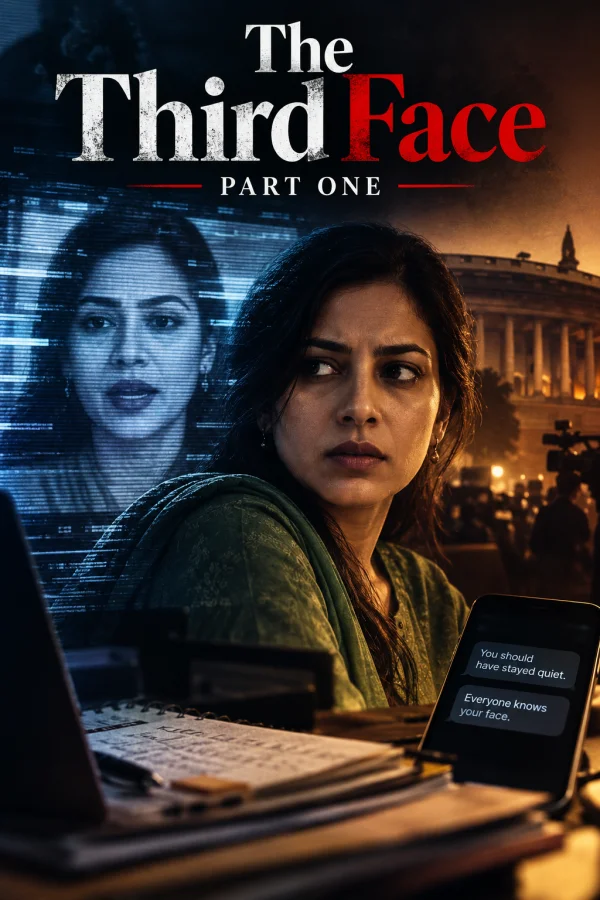
The Third Face – Part Two | The Truth Behind the Deepfake
October 27, 2026
By Virender Jaiswal
She didn't open it.
She stood against the wall beside the window with the notebook held to her chest and listened to someone knock. Once. Twice.
Then a woman, low and fast. "Vasanthi, it's Smita. Please. We don't have long."
Vasanthi said through the door, "Who's with you?"
"Nobody who works for him."
Him. She noticed the pronoun and kept it to herself. She opened the door.
Smita looked like she hadn't slept either. Behind her was a thin young man with a laptop bag, introduced as Zubair, who did digital forensics for her desk and had been awake since the video dropped.
Smita didn't waste time. "Let me clarify before you ask. The registration date in my thread came from the Trust's filings. I pulled them in March, when my editor killed the pitch. That's all it was. And the café: I was trying to get the spokesman to confirm one thing. He threw me out in ten minutes. Someone photographed it."
"I guessed some of it. Someone sent that photo around the night of the video," Vasanthi said. "But how is this related to me? Why are you here?"
"Someone sent the picture to me the morning before." Smita sat down heavily on the bed. "A blank email with the picture attached. I thought it was a threat and ignored it. Then the account that posted your video followed four people, and I was one of them." She looked at her hands. "You've seen what's been said about me since April. A photo from a party press conference, cropped so I look like I'm sitting with them. A clip of me nodding at their spokesman. One more frame every week, until by June I was the party's paid anchor on every handle that hates them."
"I saw it," Vasanthi said. "I scrolled past."
"Everyone did. That's how it works. It was slow, so nobody noticed it was a campaign. Yours was one night." Smita almost smiled. "But look at us. The party wants you hunted, and their enemies want me finished because apparently I work for the party. Two sides, each with a reason to hate one of us, and neither reason is true."
"And somebody's feeding both fires," Zubair said.
"That's why I had to find you. How, don't ask. But that's why I came. I've spent a month collecting the trolling threads: which handles, what time, who shares first. Three of the same accounts started on you the week before the video, quietly." Smita's voice was steady. "We're rivals. Fine. I'd take your ratings, maybe not cheerfully, but that's the profession, right? But nobody gets to do this to a journalist's dignity and call it competition. Alone, neither of us can prove anything. Together, maybe."
Vasanthi sat down. She hadn't expected it to feel like being forgiven for something.
"The voice is cloned from your podcast. I did some digging," Zubair said. "About fifty to sixty hours, I think. Easy to get. The face looks like it's from raw takes, your angles, the study window behind you. Every reporter at the network uploads footage to the servers, home recordings included. Anyone with access could take it in an afternoon."
"My laptop," Vasanthi suggested.
"I don't think so. It was a remote session, through the support tool the network puts on every reporter's machine." He hesitated. "The network has the footage anyway, so why would anyone try to get into your laptop?"
She told them about the phone call in the study, and the breakfast, and how she had written his name first. She felt sick doing it.
Just then her phone buzzed on the bed. A message from Dinesh, the first since she'd called him. She read it standing up.
Vasanthi, I know you might think I have something to do with it, but I promise I did not. If you need any help, anything at all, I will be happy to help. I know it's difficult, but you can trust me. I might have failed our relationship, but I am here.
She read it twice. She believed it, and that surprised her more than anything else that morning.
Zubair turned his laptop around. "I traced the render through to a company called Kaveri Digital Services. I got into their billing trail. It took a while and it's not strictly legal. This is the invoice."
One line item: Archival restoration, V. Rajagopal. The contact at the bottom was Bhaskar Rao. Approved under the code of the executive editor's office.
Vasanthi knew Kaveri. They'd built the network's mobile app.
Smita said the name quietly. "Ramanathan."
"I didn't say that."
"You didn't have to." Smita touched the screen. "But it's his code, not his hand. Half that floor can raise an invoice under it. His PA. His deputy. Anyone who's watched him sign in. This puts the thing in his house. It doesn't put it in his hands."
Then she said, "There's one more thing, and I wanted you to see the rest first."
A contact in Agarwal's office had told her Agarwal wasn't just thinking about selling. He had sold, three weeks ago, all of his stake, to a company called Lotus Meridian Holdings. The director of Lotus Meridian was the brother-in-law of the Rashtriya Navodaya Party's treasurer.
"So the party owns the network," Vasanthi said.
"Through a door nobody's looking at. And Ramanathan still has his job."
The network's debts. Her notebook. A man who had just been told he worked for the people she was investigating, and who had eight months of her work in his hands.
"Ramanathan did have my notebook overnight," Vasanthi said. "Nobody else could have..." She paused.
"What?" Smita asked.
"The account number. Nobody knew it. It was only on that page, and I said it aloud exactly once."
"Then don't guess," Smita said. "Get him to say it."
They spent the day on it. Not a crowd; Ramanathan would never say anything in front of a crowd. He'd say it only to someone he thought was alone. Zubair sewed a lens the size of a lentil into the third button of a white cotton shirt, which she'd wear under a dark jacket. A thin recorder went in her bag, with a phone beside it running a hotspot, sending everything the lens saw to Smita's laptop in a car parked on the next street. It would save the file and nothing more. Smita wouldn't publish a second of it until Vasanthi said "Now" out loud to the button.
"If he doesn't talk," Smita said, "we have nothing, and you're still hated."
"He'll talk," Vasanthi said. She wasn't sure.
She called Ramanathan.
"Vasanthi." Warm. Relieved. "Are you safe? Where are you?"
"I'm safe. I need your help. I want to see you. The Press Club, the back dining room, after it shuts tonight. Just us."
"Of course," he said. "Anything."
The back dining room at the Press Club was dark except for the lamp over one corner table. He came across the empty floor in his good grey jacket, hands already open to take hers.
"Let's turn off our phones, please," he said, gently. "I'm sorry. Everyone's phone is a risk tonight."
She put hers down and switched it off. Her bag hung on the chair behind her. He looked at it, and at her, and sat.
"Hello, sir," she said, almost cheerfully. "Thank God you're here. How is everything at the office?"
He blinked. Half a second. Nobody asked about the office on a night like this.
"Fine, fine," he said. "Everyone's worried about you." He leaned in. "What do you plan to do now? Don't worry, people forget. In a few weeks this will go quiet. Till then, stay low. I'll speak to Mr. Agarwal about arranging somewhere safe for you. We'll work out the rest later."
"Mr. Agarwal," she said.
"He's been very concerned.”
" I heard he was selling his shares."
"He did. But he's back now. In fact, he's ready to invest more. Enough to clear the network's debts."
She nodded, as if she were adding something up. "And Lotus Meridian? What happened to them?"
"That was temporary," he said. "We're all good now." He didn't ask how she knew the name. He wasn't surprised at all, as if he had expected her to find out.
"Or is it because now I can be managed?"
That threw him, and she watched it. "What are you saying? You're one of the best we have. Why would anyone need to manage you? We're asking you to stay low for your own safety. You know that."
"I do," she said. "I know a lot of things tonight." She sat up straight. "What are the last three digits of the account in the final transfer?"
He was almost thunderstruck, but he managed a smile. "Sorry?"
"The ninth. The Sri Vinayaka Trust. Only one person could have known."
The smile stayed, but she noticed his discomfort.
"Vasanthi, you've been through something terrible. Anyone could have—"
"The video says four-one-seven. I've watched it a hundred times. It's the one thing in it that was never public and never typed anywhere. You took the notebook overnight. You were also the only person I ever said it to."
"Vasanthi, this is crazy. I would never—"
"Tell me why," she said, much more quietly, not letting him finish. "I'm not going to the police. I'll probably have to leave the city by morning, but I just want to know why. Why throw me under the bus?"
Ramanathan did not fight back this time. Instead he looked at the lamp for a while. When he spoke, his voice was different, lower and tired, the voice of someone who was exhausted by the game too.
"You wouldn't give me the story, and you wouldn't be told. I tried. Agarwal wanted out, and the new people came in, and the first thing they asked was what to do about you." He rubbed his eyes. "I couldn't fire you with half the country watching. I couldn't run what you had, it would have finished the Desk and forty people with it. So yes, I photographed the notebook while it was on my desk. I'd have been a fool not to. And I called a man at Kaveri."
"Bhaskar Rao."
"You've been busy." He almost smiled. "I wrote the script myself, from your pages. Unfortunately, the number went in because it was in the pages. That was stupid. But the plan was never to hurt you. The clip was to go to three friendly channels as a leak. An hour later the network's forensics people would announce it was fake, with a report. A deepfake of Vasanthi Rajagopal, made by her enemies, saying exactly what you'd been chasing. And after that, whenever you published anything on the Trust, the party would say: this again, the same fabricated story. Nobody believes a story twice once the whole country has been told it was a fraud. Forty people keep their jobs. You keep your life."
"You'd have buried my story with my own face."
"You'd have been the victim, not the villain," he said, rubbing his palm over his face. "But their people didn't hold. They uploaded it everywhere, clean, and the report never went out. I didn't ask for the threats. I didn't ask for the address. That wasn't me. That was them, and I couldn't stop it."
"You gave them the reason."
"I gave them nothing they didn't already know, except the bank account." He shrugged. And then he smiled again. "You can't prove any of this."
"No," Vasanthi said. "I couldn't, till now." She put two fingers on the white button at her chest and said to it, clearly, "Now."
Across the city, in a parked car, Smita pressed a key.
"But now I don't have to. The world already knows. The recording is published on YouTube and Facebook and every other social media."
His phone, which he apparently hadn't switched off, started to buzz on the table. Then again. Then it didn't stop, the screen lighting his face from underneath, name after name after name.
He looked at the phone, then at her face.
For the first time in nine years she saw him look afraid.
She didn't feel anything she'd expected. Neither a win nor a loss, just relief.
She picked up her bag, stood, and walked out of the room.
Smita had the engine running. She didn't say anything. She turned the laptop around on the dashboard.
Eleven views. Then two hundred. It was past one in the morning, and the first comment, from somebody in Coimbatore, was only a question mark. By two it was forty thousand and the comments had stopped being questions. By three, the network's own handle had gone quiet.
At six, Ramanathan's name was a trending hashtag. At seven, a two-line statement from the network said he had been suspended pending inquiry. At eight, the Rashtriya Navodaya Party's spokesman, the same man who had thrown Smita out, told a camera the recording was "obviously manufactured, as was the earlier video." Zubair, eating dry toast in the back seat, said, "That's the line they wanted. Fake the first one, fake the second." He wasn't laughing.
The handles that had been calling Smita a paid anchor went quiet for a few hours, then started again, now saying she and Vasanthi had staged it together. Smita read it aloud off her phone, flatly. "Well. We're friends now. That's what it says."