
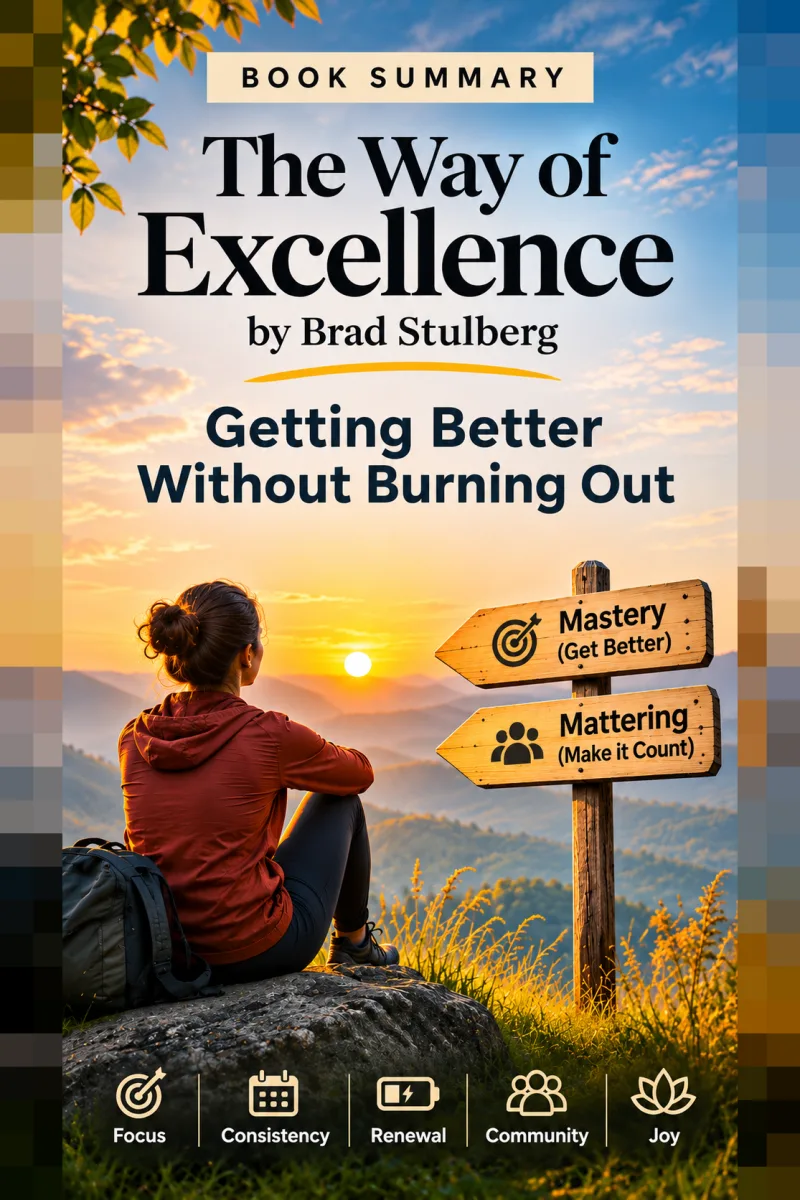
The Way of Excellence by Brad Stulberg — Getting Better Without Burning Out
Book Summaries
November 1, 2026
By NPOWS New
Most books about being great at something sell you one of two things. Either grind harder than everyone else, or find the hack that lets you skip the grind. Brad Stulberg's book rejects both. His argument is that excellence isn't a trophy for a gifted few, and it isn't a productivity system. It's a way of engaging with what you do: fully present, using your strengths, on something that matters to you. Done that way, it's also one of the most reliable sources of deep satisfaction a person can have.
He defines it as two things together. Mastery, getting genuinely better at something worthwhile. And mattering, feeling that the effort counts for something beyond yourself. Either one alone falls short. You can become exceptionally good at a job that feels meaningless, or devote yourself to a cause without building the skill to make a real contribution. Excellence needs both: getting better at something, and believing the effort matters.
What excellence is not
Stulberg spends real time on the impostors, because they're what most people are actually chasing.
Perfectionism demands flawlessness, while excellence accepts that improvement is messy and repeated. Obsession burns hot and burns out, while excellence includes rest so you can keep going for years. Optimization treats you like a machine to be tuned, while excellence stays curious and human. Simple happiness wants good feelings all the time, while excellence includes frustration, boredom, and doubt on the way to something deeper. And flow, the famous state of total absorption, isn't the same thing either. You can be in flow arguing with strangers online or at a slot machine. Excellence is flow pointed at something you value, plus the unglamorous work that surrounds it.
Why we're wired for it, and why it feels so hard now
Part One makes the case that striving to get better is built into us. Stulberg starts from biology: living things constantly respond to their surroundings in ways that support survival. In humans that drive becomes richer, and much of it shows up as feelings. Good feelings say move toward this, bad ones say move away. Stulberg leans on the neuroscientist Antonio Damasio's research: patients with damage to the brain's emotional valuation areas kept their intelligence but lost the ability to make sound real-world decisions. Feelings, in this view, aren't simply a distraction from good judgment. They're part of the machinery that makes it possible.
He also draws on the familiar four-stage model of skill: first not knowing what you don't know, then seeing your mistakes, then getting it right through conscious effort, and finally doing it by feel. That last stage is where the best performers live, which is why violinists, golfers, and climbers talk about "feel" so much.
So why does it feel so hard now? Stulberg's answer is mismatch. A brain built for scarcity now lives surrounded by products engineered to hijack its oldest drives: junk food, endless feeds, gambling apps. The result is what he calls restless exhaustion, feeling simultaneously wired and drained. His fix is environmental, not heroic. Our surroundings invite behavior, the way stairs invite climbing and a phone on the desk invites checking. So he works with his phone in another room, edits drafts on paper, and keeps a weekly day without devices.
He also borrows from philosophy, especially Robert Pirsig's idea of Quality from Zen and the Art of Motorcycle Maintenance: the state where the gap between you and what you're doing disappears and you simply care. Hands-on crafts like woodworking, lifting, or running help because they give honest feedback. The weight goes up or it doesn't.
The sixteen principles
Part Two turns all this into practice. A few stand out.
Care comes first. You can't fake caring about something, so explore widely, quit things that don't fit your values, and commit hard when something does. Stulberg also suggests building an identity like a house with many rooms, so a setback in one room doesn't bring the whole house down.
Goals are vehicles, not destinations. He warns against the arrival fallacy, the belief that hitting a big goal will finally make you feel complete. It rarely does, so choose goals for who they'll make you along the way.
Consistency beats intensity. His phrase is "raise the floor": make your bad days slightly less bad instead of chasing the occasional great day. Over years, the floor is what decides where you end up.
Trade-offs replace balance. You can't give everything equal weight, so choose your priorities on purpose and give each important area of life a minimum dose of time to keep it alive.
Focus gets practical. Research by Gloria Mark found that the average time people stay on one screen before switching has fallen to about 47 seconds. That measures how often we switch, not how long we're capable of concentrating. Stulberg's counter is deep-work blocks of fifty minutes to two hours with devices physically out of reach.
Discipline is what turns motivation into action, and he notes research showing that doing something productive lifts mood more reliably than waiting to feel like it first.
Renewal is part of the work, not a break from it. The book's model is simple: a meaningful challenge is the stimulus for growth, and recovery is when you actually adapt. Real rest means not checking email, not tracking your recovery like a project, and not exercising self-control for a while.
Confidence is built from evidence, the accumulated proof that you've handled hard things before, not from talking yourself up. Patience matters because real work takes years; Darwin spent more than twenty years developing the ideas behind his theory of evolution, and Katalin Karikó spent decades on the mRNA research that later made COVID vaccines possible. Staying in the game is what gives luck a chance to find you.
The remaining principles round it out. Routine, with a suggested set of a few daily, weekly, and monthly practices, held loosely. Gumption, Pirsig's word for steady forward momentum. Curiosity, which competes with fear in the brain and wins if you feed it. Failure, which hurts, happens to everyone, and is followed by the next attempt. Community, because the people around you shape your effort more than you think. Joy, the most sustainable fuel there is: passion driven by enjoyment lasts, while passion driven by outside approval burns people out. And completion: stopping to recognise what you've finished before chasing the next target, the way Gregg Popovich's San Antonio Spurs built team dinners into their seasons.
One practical adjustment
The book's practices assume some control over your own time: two-hour focus blocks with your phone in another room, a weekly device-free day, room in the week for a craft. That fits writers, coaches, and many professionals. It's harder for a parent of a toddler, a nurse on call, or anyone in a customer-facing job where being reachable is the job. The principles still hold for them, but the practices shrink. A twenty-minute block before the house wakes up, devices away for one evening instead of a whole day, a craft practiced in small pieces. Stulberg's own idea of a minimum effective dose is the right tool here, and it's worth applying to his own suggestions. The point isn't to find two uninterrupted hours a day. It's to protect whatever meaningful attention your circumstances allow.
So is it worth reading?
Yes. It's one of the most thoughtful books on performance in years, and a welcome change from both hustle culture and life-hacking. Its central idea, that getting better at something you care about is a source of deep satisfaction rather than a route to burnout, is both well argued and genuinely useful.
Read Part One for the reframe, then use Part Two as a menu. Pick the two or three principles that address where you're stuck, whether that's consistency, focus, patience, or rest, and work on those for a season. The book is at its best when you treat excellence the way it suggests: as a practice, not a finish line.