
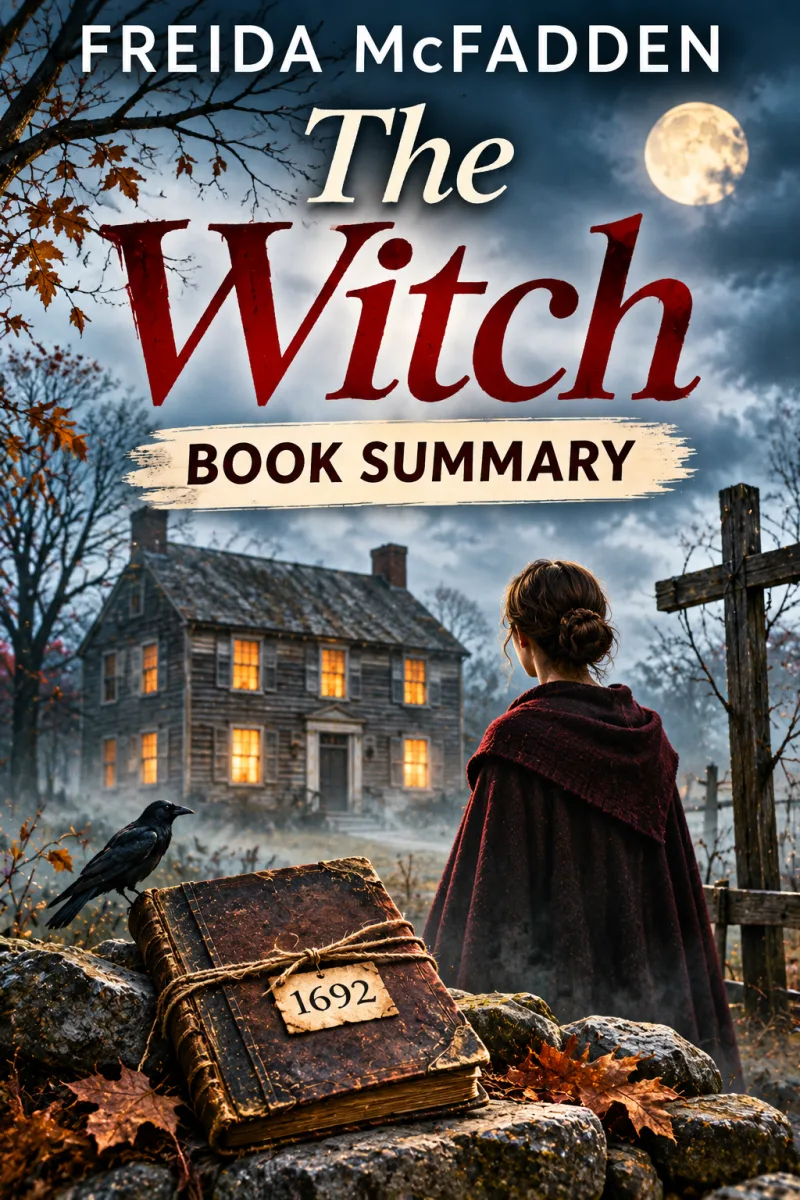
The Witch by Freida McFadden — An Old House, a Ghost and a Witch Trial in 1692
Book Summaries
November 12, 2026
By NPOWS New
Julia Barlow is twenty-seven, out of work and out of money, so she moves into Pemberton, the old family house in northern Massachusetts where her grandmother lives with her sister. The house was built in 1660, and it has a reputation. A local museum curator wants to buy it. Julia's job is to decide whether her grandmother is still safe living there and whether the offer is fair. Instead, she finds herself drawn into the story of a woman who lived in the house more than three hundred years ago and never left.
The Witch, published on 6 October 2026 by Poisoned Pen Press, follows Freida McFadden's Dear Debbie in January and The Divorce in May. It is also a change of direction. McFadden is best known for domestic thrillers such as The Housemaid. This one mixes a ghost story with historical fiction set during the witchcraft panics of colonial New England.
Two women, two timelines
The book alternates between two first-person narrators. In the present, Julia tries to manage her grandmother, her great-aunt, the museum's offer and a series of increasingly strange events in the house. In 1692, Caroline Eldridge, the young wife who once lived at Pemberton, tells her own story. Her only real friend in the town of Woodhaven is Hitty Atkins, an old woman who sells herbs and remedies. When Hitty is accused of witchcraft, suspicion soon begins to turn towards Caroline herself, and her servant, Molly, becomes a key witness. The publisher's own description tells us that a woman from the house was executed for witchcraft in 1692, so the question in these chapters is less what happens than how, and who is responsible.
The chapters are short, often only a few pages, and most end on a turn. It is classic McFadden pacing, and it makes the book very quick to read.
The past is the stronger story
Reviewers agree that Caroline's chapters are where the book comes alive. The fear and suspicion in Woodhaven build steadily, and McFadden shows clearly how an accusation could become impossible to escape once a town had made up its mind. Kirkus called Caroline's storyline gripping, with high stakes and satisfying twists. The Bookish Elf's review, which gave the book 4 out of 5, called Hitty one of its most vivid characters and praised the gentle way McFadden writes Julia's grandmother.
As usual, there are twists, and this summary won't reveal them. The Bookish Elf thought they were well planted rather than pulled out of nowhere.
The present is weaker
Julia's half of the book is a different matter. Kirkus found her storyline weakly plotted, described the modern villains as Scooby-Doo antagonists and judged the book overall "a diverting if largely forgettable trifle." The romance has little chemistry, Julia is passive for long stretches, and a ghost-hunter subplot slides into slapstick. Some of the scares in the house also strain belief.
Be aware, too, that this is darker than a typical cosy ghost story. The 1692 chapters include execution by hanging, threats of sexual violence and a humiliating search, and the present-day story deals with dementia and the neglect of an elderly relative.
Who should read it
If you've read every McFadden thriller and want to see her try something different, The Witch is worth your time, mostly for Caroline and Hitty. Readers who enjoyed historical-witch novels will find the 1692 chapters satisfying. If you want McFadden at her twistiest and most modern, Dear Debbie or The Housemaid is a better pick.
Our verdict
The Witch is a fast, uneven book with a strong historical story inside a weaker modern one. Read it for the past, forgive the present, and treat it as a quick autumn read rather than McFadden's best.