
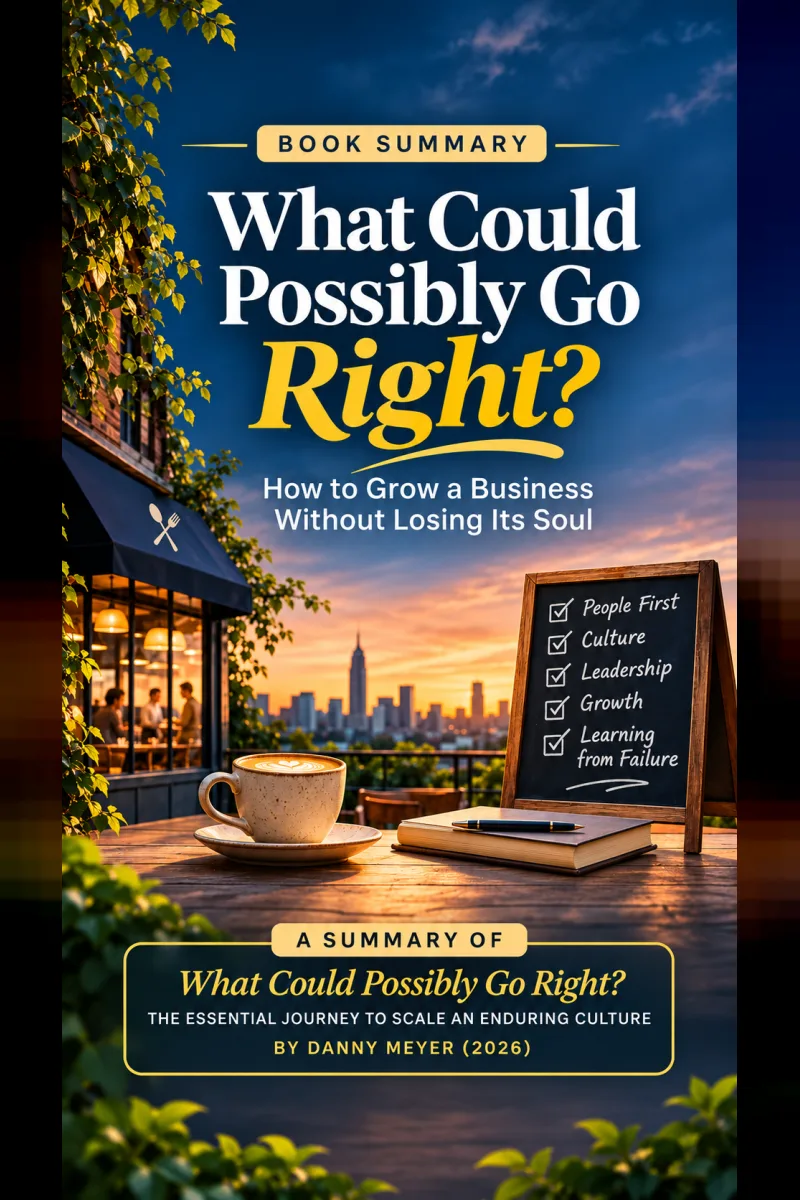
What Could Possibly Go Right? by Danny Meyer — How to Grow a Business Without Losing Its Soul
Book Summaries
November 2, 2026
By NPOWS New
In 2006, Danny Meyer was one of the most admired restaurateurs in the United States. He owned a small group of celebrated New York restaurants, including Union Square Cafe and Gramercy Tavern, and he had just published Setting the Table, a book about the people-first approach to hospitality that made them famous. He could also say he had never closed a restaurant.
Twenty years later, the picture looks very different. The organisation and businesses that grew out of Meyer's original restaurant group, including Shake Shack, have expanded to roughly 700 locations across 24 countries. And by his own count he has opened 27 restaurants, ten of which have closed. What Could Possibly Go Right? is about what happened in between: how you keep a culture alive when a business grows far beyond the founder's ability to be in every room, and what failure taught him along the way.
The closing that changed his mind
The book's turning point is a failure. When Meyer closed Tabla, his Indian-inspired restaurant, he felt a deep sense of shame. He had built part of his identity on never having to do it. He has also said he kept it open longer than he should have, partly because he was so attached to the restaurant and what it represented. Fear of failure, it turns out, can look like refusing to let go as much as refusing to take risks. Looking back, he describes how that fear of failure had quietly been holding him back as an entrepreneur and as a leader. A leader who is terrified of mistakes, he argues, ends up protecting the business from risk, and in the process smothers the creativity of the people who work for it.
That shift gives the book its title and its tone. Instead of asking "What could possibly go wrong?", the question that makes people cautious, Meyer wants leaders to ask what could go right, and to accept that some things will fail along the way. One line from the book sums it up: the road to success is paved with mistakes well handled.
Enlightened hospitality, revisited
At the centre of everything Meyer has built is an idea he calls Enlightened Hospitality. It turns the usual business order upside down. Employees come first, followed by guests, the community, suppliers, and investors. How employees feel shapes how they treat guests; happier guests come back; strong community and supplier relationships support the business; and the resulting success benefits investors. Meyer calls it a "virtuous cycle." Profit isn't ignored. It's the outcome of getting those relationships right. He also rejects the old rule that the customer is always right. Nobody is always right, he says, including him and his staff. What matters is doing something great for the guest, not deciding who was right.
A story in the book shows what this looks like in practice. When a server spilled olive oil on a guest's suede dress, the company didn't stop at an apology. A replacement dress arrived by courier the next morning, along with a gift basket and a $500 gift card. That's the kind of response that turns a mistake into loyalty, and it's the kind of story Meyer uses to show how a culture behaves when no one from head office is watching.
Scaling relationships, not just systems
Most business books about growth are about operations: supply chains, standardised processes, unit economics. Meyer's question is harder. How do you scale human relationships? A single restaurant can run on the owner's personal example. Seven hundred businesses can't.
His answer is that culture has to be built deliberately, through hiring, training, and language people actually use. The book introduces several of the tools his company uses, including the Hospitality Quotient, his long-standing idea that you should hire for emotional skills like kindness, curiosity, and self-awareness as much as for technical ability, alongside newer ideas such as the Rule of Two and the Four Gears of Leadership. It also includes short mantras meant to travel across a large organisation, like "Change Your Grip," "Think Like a Winemaker," and, more bluntly, "Don't F'ing Settle." Practical outlines and checklists on managing change and weighing the risks of new initiatives round it out.
The real challenge is making these principles useful to someone working in a restaurant thousands of miles from the founder. That means giving people a shared language for making decisions, not a list of corporate values to memorise. The test of a culture is what people do when something goes wrong and no manager is there to tell them what to do.
The most important idea is that culture is never finished. It's not something you build once and then own. It's an aspiration you have to keep working towards, especially as you grow.
Who it's for
Although it's written by a restaurateur, the book isn't really about food. The lessons are about leadership, hiring, and keeping standards high as an organisation gets bigger, and they apply to almost any growing business, from a start-up to a team inside a large company. Readers who loved Setting the Table will find this a natural sequel. Readers who haven't read it can start here.
What to keep in mind
Early reception has been positive. Kirkus called it worthy reading for budding entrepreneurs and a valuable study in trial and error. The book has also been endorsed by business writers Adam Grant and Daniel Coyle, who praised Meyer's approach to building a lasting culture. Kirkus did note a couple of weaknesses: Meyer's management mantras are repeated often enough to wear thin, and his impatience sometimes shows on the page.
It's also worth reading with some perspective. This is a founder writing about his own company, so it naturally focuses on what worked and what he learned, rather than offering an outside, critical view of his business. And the examples come from hospitality, where the culture-first model fits especially naturally. Leaders in industries with very different pressures will need to translate some of it to their own situation.
So is it worth reading?
Yes, especially if you lead people or are trying to grow something without losing what made it good in the first place. Its biggest strength is honesty about failure. Meyer doesn't present himself as someone who got everything right. He shows how a person who was afraid of failing learned to treat mistakes as part of the job.
If you're looking for a detailed operations manual, this isn't it. If you want to understand how culture actually spreads, or fails to spread, as a business grows, it's one of the more useful books on the subject from someone who has done it at scale.