
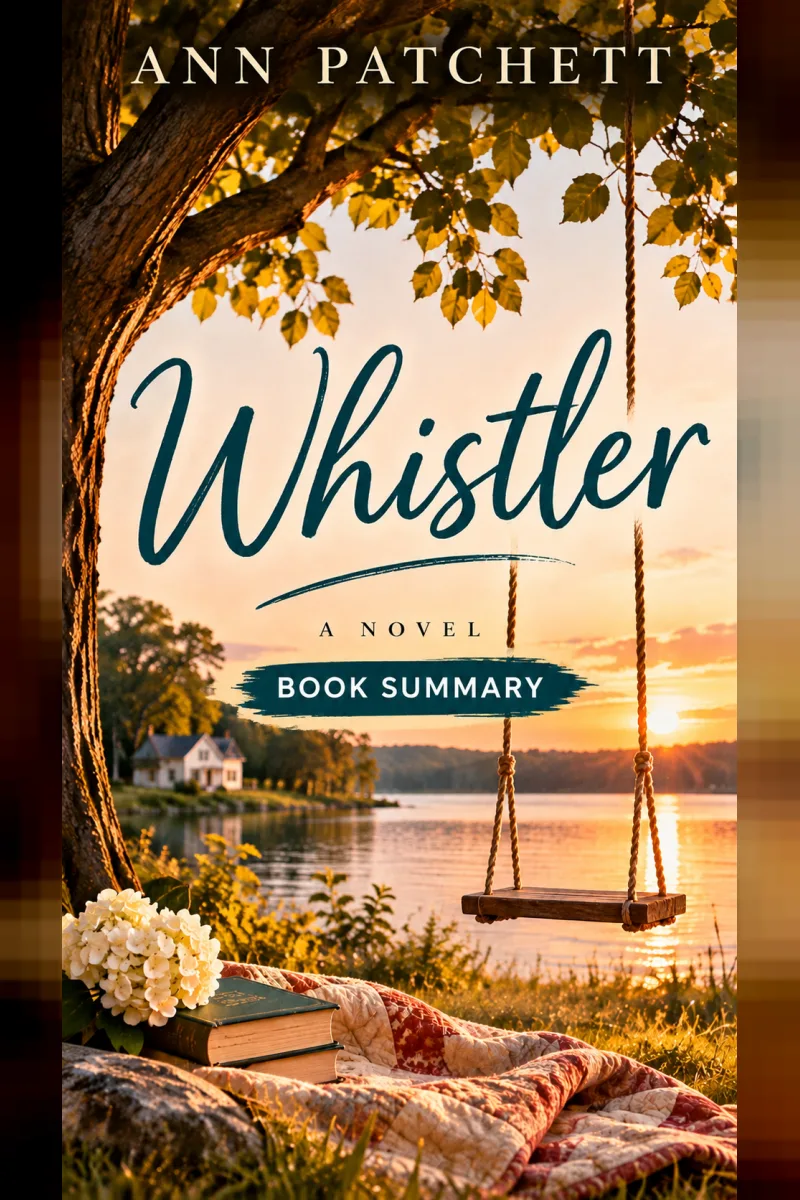
Whistler by Ann Patchett — A Chance Meeting at the Met and a Family's Lost Story
Book Summaries
November 11, 2026
By NPOWS New
Daphne Fuller is in her fifties, a literature teacher, and spending the summer largely on her own. One day, at the Metropolitan Museum of Art in New York, she runs into a man she hasn't seen since she was a child: Eddie Triplett, now in his eighties, who was once her stepfather. Their family was broken apart decades earlier, after a frightening night in a car on a snowbound mountain, when Daphne was nine. Her mother divorced Eddie and cut him out of their lives.
That chance meeting is the start of Whistler, Ann Patchett's novel published by Harper on 2 June 2026. Patchett is one of America's most admired novelists, the author of Bel Canto, Commonwealth, The Dutch House and Tom Lake, and co-owner of Parnassus Books, an independent bookshop in Nashville. Whistler returns to the themes she writes about best: families, secrets, and the stories we tell ourselves about the people who raised us.
A story about memory
Daphne narrates the novel herself, and the book moves between the present-day summer and her memories of childhood. As she spends time with Eddie, a retired publishing editor, she begins to question the family history she has always accepted. What really happened that night on the mountain? Why did the adults make the choices they did? And what was hidden from the children?
It helps to know the family. Daphne has had three fathers. Her biological father, Buddy Zabriskie, a deep-sea fisherman, left early. Eddie Triplett was her first stepfather. And Lucas Ekker, a self-help author, is her mother's current husband, living with her in retirement in Massachusetts. Daphne's own husband, Jonathan, much older than her and retired, is away for much of the summer, which gives her room to look back. Her younger sister, Leda, a therapist, helps her draw out the memories of that night.
The title is tied to the accident itself. On that night in the car, a story about a woman whose life was saved by her horse, Whistler, came to matter in ways Daphne only understands as an adult. How and why is best discovered while reading.
A kind book on purpose
What sets Whistler apart is its warmth. Many family novels are built on cruelty. This one is mostly about people trying, imperfectly, to do right by each other, and about the love that can exist between stepparents and stepchildren long after the marriage that connected them has ended.
Patchett has written before about having more than one father, in her essay "My Three Fathers", and the novel draws some of its emotional authority from that territory. The book is also a tribute. It's dedicated to Jim Fox, a former publishing executive and close friend of Patchett's, and Leigh Haber, reviewing for the Los Angeles Times, described Eddie as Fox reborn in fiction. That explains the novel's other great subject: the power of books and stories to carry people through. Kirkus, in a starred review, called it a tribute to the "infinitely redemptive power of storytelling". In The New York Times, Helen Schulman called it intimate and entertaining, arguing that it makes a strong case for kindness in serious fiction. Laura B. Martens, writing for The Harvard Crimson on 25 August 2026, gave it five stars, praising a novel that feels so real it reads almost like memoir.
The case against
Not everyone was won over by that gentleness. In The Guardian, Beejay Silcox called it "top-shelf comfort food" but found it "all so neat", complaining that it often reads like a gratitude journal. The critic Ron Charles, while enjoying it, warned that readers hoping for the intensity of Bel Canto or State of Wonder may wait in vain. Mia Rhee, in the Chicago Review of Books on 12 June 2026, found some of the literary and publishing references a little too on the nose.
These are fair points, and they describe a real trade-off. Because almost everyone in Whistler means well, the tension comes from what was hidden rather than from anyone's cruelty, and once the past is understood there's little left to fight over. Readers who come to fiction for friction may find the final stretch too gentle, with every thread tied off. Readers who want a story about repair rather than damage will find that same neatness consoling.
Our verdict
Whistler is a quiet, beautifully written novel about memory, forgiveness and the family we choose to keep. Its kindness is its strength and, for some readers, its limit. It isn't Patchett's most dramatic book, but it may be one of her most tender.
Read it if you loved The Dutch House or Tom Lake, or if you're interested in how divorce echoes across generations. If you prefer novels with more edge, start with Bel Canto instead.
Questions for book clubs
1. How reliable is Daphne as a narrator of her own childhood?
2. What does the novel suggest about the bond between stepparents and stepchildren?
3. Why do you think the adults kept so much from the children, and were they right to?
4. Is the book's kindness a strength or a weakness? Did you want more conflict?
5. How does the story of the horse, Whistler, change the way you see Daphne's family?