
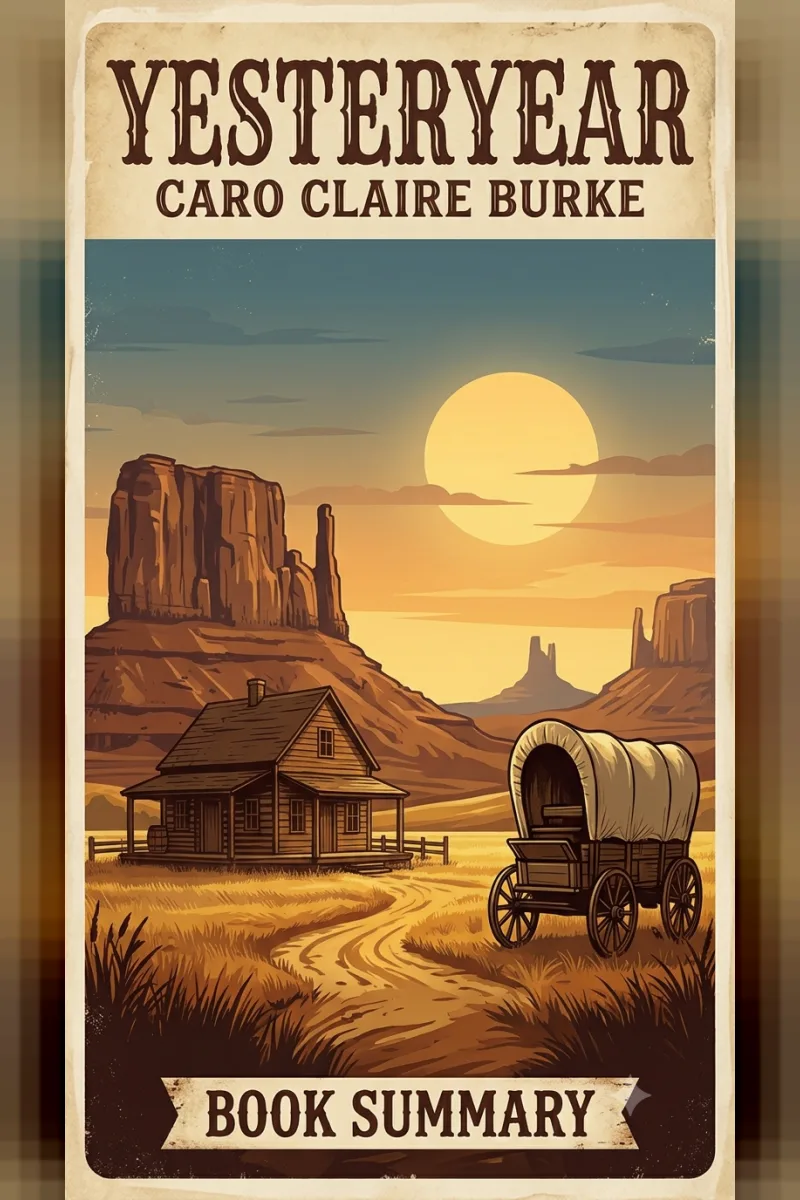
Yesteryear by Caro Claire Burke — What Happens When a Tradwife Has to Live the Life She Sells
Book Summaries
November 10, 2026
By NPOWS New
Natalie Heller Mills sells the past for a living. On her feeds she is a ranch wife in a linen dress, kneading bread and raising a houseful of children far from the noise of modern life. Millions of people watch. Then one morning the costume stops being a costume. She wakes up in 1855, in a cabin with no heat, no running water and none of the hidden staff who made her old-fashioned life look so easy.
That reversal is the engine of Yesteryear, Caro Claire Burke's first novel, published by Knopf on 7 April 2026. Burke trained at the Bennington Writing Seminars and co-hosts a politics and culture podcast, and she has said the book grew out of the winter of 2024, when she joined TikTok and found herself absorbed by "tradwife" videos: women presenting traditional homemaking as an ideal way to live. The result is a satire with the pace of a thriller, and it became one of the most discussed debuts of the year.
A narrator who knows exactly what she's doing
The book belongs to Natalie's voice. She speaks straight to the reader, and she is funny, vain, observant and often cruel. What makes her interesting is that she isn't fooled by her own brand. Behind Yesteryear Ranch, her homestead on a huge property in Idaho, there are nannies, farmhands, modern appliances and a producer who shapes every video. Natalie knows all of this. She is less a true believer than a sharp businesswoman who has found a profitable story and learned to tell it well.
Burke also shows how she got there. In chapters that move back through time, we follow Natalie from Harvard to her marriage to Caleb, the son of a powerful political family, and on to her rise online. The change is gradual rather than sudden, and that is one of the book's most convincing choices. There is no single moment when Natalie decides to deceive people. The performance simply grows until there is very little left of the person underneath.
The business of looking simple
The sharpest parts of Yesteryear are about attention as an economy. Natalie studies her audience the way a trader studies a market. She keeps a close eye on a group of hostile followers she calls "the Angry Women", because outrage keeps people watching too. And with her father-in-law running for president, every image of a happy, traditional family carries political value as well as commercial value.
The novel is also quietly pointed about her children. They are part of the product, filmed and presented to strangers long before they are old enough to understand what that means. In her review for The Guardian, Rhiannon Lucy Cosslett singled this out as one of the book's strengths: its interest in children who cannot consent to being turned into content. It is the question readers are most likely to carry away with them.
1855: the fantasy meets the work
When Natalie wakes up in the cabin, the children look like hers but behave like strangers, and Caleb has become a hard, competent farmer who expects her to do all the work she has only ever pretended to do. At first she assumes she is the victim of a prank or a brutal reality show. The question of what is really happening, and whether there is a way back, drives the second half of the book.
These chapters make the satire physical. Romantic ideas about the old days fall apart when the work is real: hauling water, washing clothes by hand, surviving a winter. The point is not that the past was worse, or that homemaking has no value. It's that the version Natalie sold was never about the past at all. It was a fantasy that depended on everything it claimed to reject.
Where critics disagree
Reviews have been strong but not unanimous. Bookreporter's reviewer was enthusiastic, calling it an "instant modern classic", and BookBrowse's Kim Kovacs described it as a compulsively readable debut. Most readers agree that Natalie's voice carries the book.
The doubts are about depth. Kovacs found the cabin sections less engaging than the present-day story and felt the historical detail was thin. Cosslett went further. In her view, the novel raises the politics of the tradwife movement but largely leaves them unexplored, and it "largely fails to meet the political moment." Readers who want a serious examination of the movement, rather than a satire of one influencer, may agree.
There is also the question of Natalie herself. She grows more selfish as the book goes on, and some readers will find her exhausting rather than compelling.
Our verdict
Yesteryear is best read as a satire of influence, not as a historical novel or a full analysis of a political movement. On those terms it succeeds. It's fast, smart about how online attention becomes money, and memorable mainly because of its unpleasant, brilliantly drawn narrator. Its weaknesses are real: the 1855 world is sketchy, and the bigger political questions are raised more often than they are answered.
Pick it up if you enjoy uncomfortable comedy and narrators you can't trust. Skip it if you need someone to root for.
Questions for book clubs
1. How much of what Natalie tells us do you believe, and did your view of her change as the book went on?
2. Was there a moment when Natalie stopped believing in the life she was selling, or did it happen slowly?
3. Why do you think audiences keep watching lives they don't admire, including people who openly dislike Natalie?
4. What does the book suggest about children who grow up as part of a family's online brand?
5. Does the novel criticise women who choose traditional home life, or the business built around selling that image? Where do you think Burke draws the line?
6. Did the book take the politics of its subject far enough, or was it right to keep the focus on one woman?