How to Write a Storyline: Building a Plot That Holds Together
The novelist E. M. Forster drew a famous distinction. "The king died and then the queen died" is a story, he said, a sequence of events. "The king died, and then the queen died of grief" is a plot. The difference is one word: because.
That's most of what you need to know about writing a storyline. Things don't just happen one after another. Each thing happens because of the last one, and makes the next one possible.
Start with a want and a wall
Every storyline begins with someone who wants something and something in the way. Without both, you have a situation, not a story.
The want doesn't have to be grand. In Olivia Mukherjee's The Biryani Was for Bruno, Meera wants her family to see the work she does every day. The wall is that they've never had to notice. Her plan, which is simply to stop cooking for anyone except herself and the dog, is what sets the story in motion.
Write your own story's engine in one sentence: "[Character] wants [goal], but [obstacle], so [action]." If you can't fill in the blanks, the plot may wander. Some quieter literary stories bend this rule, but even they usually have a pressure of some kind pushing on the character.
Link scenes with "because" and "but"
The screenwriters of South Park, Trey Parker and Matt Stone, have a well-known rule of thumb: if the beats of your story are joined by "and then", it's boring. They should be joined by "therefore" or "but".
Try it on your outline. "She goes to the party and then she meets an old friend and then they go home" is flat. "She goes to the party, but her ex is there, so she leaves with an old friend, but the friend has a secret" is moving.
Make it harder before you make it better
The middle of a story is where pressure builds. Each attempt your character makes should fail, or succeed at a cost, and the situation should get tighter.
Meera's story is organised by days, and you can feel the pressure rising. On Day Two, her husband stares at a wardrobe full of worn clothes and realises nobody is coming to rescue him. By Day Three, the mood has shifted:
Nobody asked what's for breakfast. This was progress. Also defeat.
The family isn't just inconvenienced any more. They're changing, reluctantly.
Plan the turn
Most satisfying storylines have a turning point: a moment where something shifts and the ending becomes possible. A revelation, a decision, a reversal.
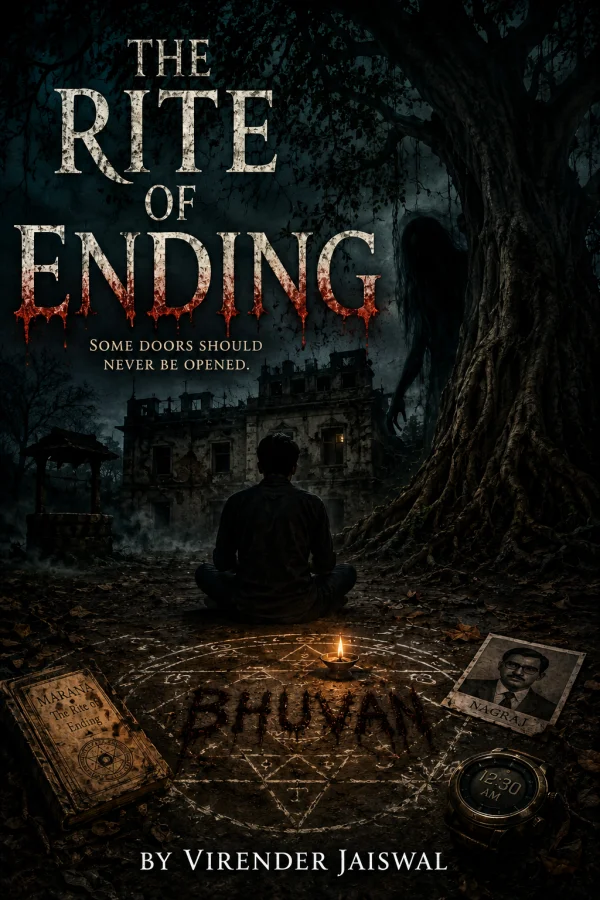
In Virender Jaiswal's The Rite of Ending, a humiliated student performs a ritual against his professor. The turn arrives when the name scratched in the soil changes on its own:
Nagraj's name vanished. In its place, thick, muddy letters pushed up from underground, spelling out a new name:
B H U V A N
Everything before that moment builds toward revenge. Everything after it is about survival. A good turn reframes the story you thought you were reading.
Endings that feel earned
An ending works when it answers the question the story asked, in a way that's surprising but makes sense looking back. It doesn't have to be happy. It has to be a consequence.
Meera's story ends with the family cooking together, and a single line from her that lands because of everything before it. The rite story ends with a door only half closed. Both endings grow out of what the characters did.
If your ending relies on coincidence, a stranger arriving with the answer, or a character suddenly becoming someone else, go back and plant the seeds earlier.
Three-act structure, briefly
You'll hear about three acts everywhere. It's a useful map, nothing more. Act one sets up the character, the want and the problem. Act two complicates everything until the turn. Act three resolves it.
Meera's three days fit this neatly, almost by accident. Many stories don't, and that's fine. Use structure as a checklist after you draft, not as a cage before you start.
A quick exercise
Take a story you know well, a film or a favourite novel, and write its plot in ten sentences, each one starting with "But" or "So". Then do the same for your own idea. Wherever you find yourself writing "And then", check whether the events are really connected. If they aren't, that's a weak link worth fixing.
If you're still at the idea stage, our guide to what makes a story compelling is a good companion to this one.
Ready to put this into practice?
BrightChapters' Write page is free to use, with no account needed to start a draft.
Start Writing Read for InspirationKeep reading: new on BrightChapters
Stories published by writers on BrightChapters. Free to read, no account needed.