How to Write a Plot Twist That Feels Fair
A great twist does two things at once. In the moment, it shocks you. A second later, it clicks, and you realise the clues were there all along. That second feeling is what separates a twist readers love from one they resent.
Here's how to build the first kind.
Plant the clues in plain sight
A fair twist is hidden, not missing. As a rule of thumb, the key information should be on the page before the reveal, just placed where they won't give it much weight.
Virender Jaiswal's thriller The Third Face is a good example. A journalist is trying to work out who made a deepfake of her. Late in part one, rereading the transcript for the tenth time, she catches a line she'd missed: the fake mentions a bank account ending in four-one-seven. That number exists in only one place:
She hadn't put that number in an email, a draft, or any file on any laptop. It was on that page and in her head. And she had said it out loud exactly once, in the last week before the video, in a room with the lamp on.
One clue narrows everything down to a single moment in a single room, and attentive readers can start working it out for themselves. That's what makes it fair, and what makes it sting.
Misdirect, but don't lie
Misdirection means giving readers a more obvious suspect, explanation or worry to look at, so they don't examine the real one too closely. In The Third Face, the journalist works through her suspects one by one. Each has a plausible motive, which spreads the reader's attention thin.
What breaks trust is a narrator who flatly lies to the reader without the story having set up that possibility. Characters can lie to each other, and to themselves. Unreliable narrators and selective narration are fair game too, as long as the story plays by the rules it has established.
Make the twist change the meaning
A twist that only changes the facts is a surprise. A twist that changes what the story is about is a revelation.
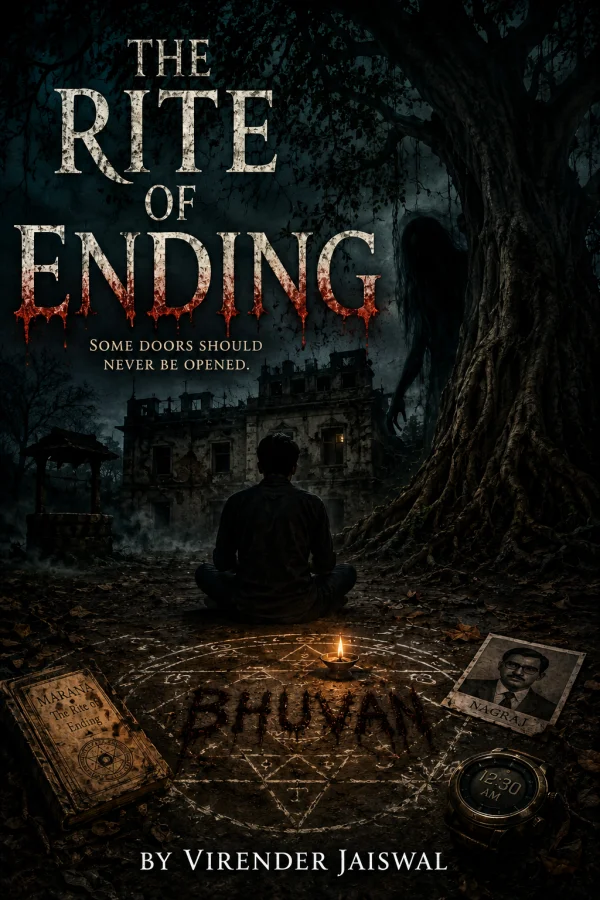
In Virender Jaiswal's The Rite of Ending, a student performs a ritual against the professor who humiliated him. The twist comes when the ritual turns:
Nagraj's name vanished. In its place, thick, muddy letters pushed up from underground, spelling out a new name:
B H U V A N
Suddenly it's no longer a revenge story. It's a story about what revenge does to the person who seeks it.
Timing matters
Twists usually land best near a turning point: the end of an act, the end of a part, or the final pages. An early twist can work brilliantly if it launches a new phase of the story, but then the rest has to live up to it. If it comes in the last line, make sure the story still holds up for readers who saw it coming.
A good test: imagine a reader guesses your twist halfway through. Is the story still worth finishing? If yes, you've built something sturdy.
Cheap twists to avoid
It was all a dream. Rarely earned.
The secret twin, or any character introduced only to explain the twist.
Withheld knowledge. A first-person narrator who knew the answer all along but simply chose not to think about it for 300 pages.
Twists for their own sake. If the reveal doesn't connect to the characters' choices or the story's themes, it's a gimmick.
Test it on a reader
You can't judge your own twist, because you already know it. Give the draft to someone and ask two questions afterwards: when did you guess? And did it feel fair? If readers find the reveal convincing looking back, even the ones who guessed it, you're there.
Posting a story on BrightChapters is an easy way to find out. Readers will tell you in the comments whether they saw it coming. For the basics of building the plot around your twist, see our guide to writing a storyline, and for landing what comes after, how to end a story.
Ready to put this into practice?
BrightChapters' Write page is free to use, with no account needed to start a draft.
Start Writing Read for InspirationKeep reading: new on BrightChapters
Stories published by writers on BrightChapters. Free to read, no account needed.