How to End a Story: Endings That Land
Readers forgive a lot in the middle of a story. A slow chapter, a scene that wanders. A bad ending is harder to forgive, because it's the last thing a reader carries away.
The good news is that endings can be planned, revised and improved like any other part of a story. Here's how to think about them.
Know what question your story asked
Most stories raise a question near the start, even quiet ones. Will she get the job? Who made the video? Will the family ever notice what Meera does? The ending is where that question gets answered, even if the answer is "no" or "not in the way you expected".
If your ending feels flat, check whether it answers the question you actually asked. Many weak endings answer a different, smaller question, or none at all.
The closed ending
The central conflict is resolved. The mystery is solved, the couple are together, the family sits down to dinner. Closed endings feel satisfying when they're earned.
Olivia Mukherjee's The Biryani Was for Bruno closes with Meera at peace, the house reset, and the dog at her side:
"You and me," she said smiling, scratching behind his ears. "We fixed it."
It's warm, it's funny, and it lands because the dog has been her quiet ally from the first scene. A closed ending works best when it pays off something planted early.
The open ending
The main tension resolves, but something lingers. A door is latched but not locked. Open endings trust the reader to keep thinking.
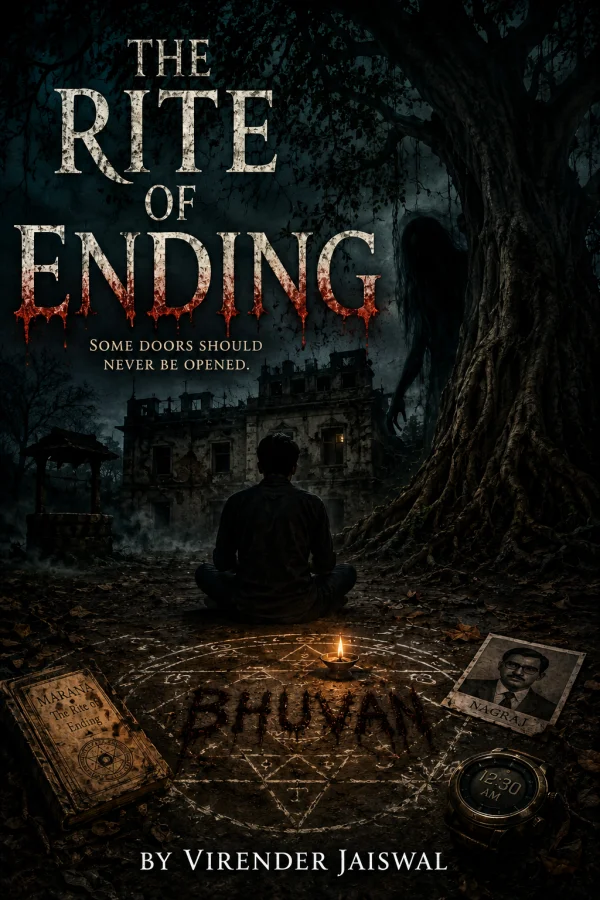
Virender Jaiswal's The Rite of Ending saves its last line for exactly this. Bhuvan survives the ritual, barely, and asks his father if the thing is dead:
"No," he said softly. "You opened a door. I only managed to latch it."
The immediate danger is over. The larger danger isn't. That's an open ending that feels deliberate rather than unfinished.
The sting in the tail
Some stories end with a short final turn that changes how we see everything. It's a favourite in horror and crime.
In Virender Jaiswal's The Iron Box, after the climax, the story steps back for two short paragraphs. The official verdict:
The coroner called the death a heart attack.
And then the lawyer quietly puts the word out for someone new, someone who won't ask about the last man who took the job, "or the one before him". Five words, and the horror turns from one night into a pattern.
End on an image, not a lecture
One of the most common ending mistakes is explaining what the story meant. "And she finally understood that family is what matters most." Readers usually got there on their own a paragraph earlier.
Try cutting your last paragraph and see if the story ends better on the one before. It often does.
Other traps to avoid
The rescue from nowhere. A character we've never met, a lucky accident, or a sudden new power solves the problem. If something saves the day at the end, plant it earlier. (In The Rite of Ending, the father's knowledge of the old rituals is set up from the first paragraph, when we learn the house was built by a Tantra practitioner.)
It was all a dream. Almost always a cheat, unless the whole story has been playing fair about it.
Running past the ending. The emotional climax happens, and then the story keeps going for three more pages of tidying up. Get out sooner.
Ending too fast. The opposite problem: a long build-up resolved in a sentence. Give the climax room to breathe.
Write the ending early
Some writers draft the ending first, or at least know it, so the whole story can lean toward it. Others discover it. Either way, once you know your ending, go back through the draft and make sure the beginning sets it up. The last line should feel like it was waiting there all along.
For more on what comes before the ending, see our guides to writing a storyline and story openings.
Ready to put this into practice?
BrightChapters' Write page is free to use, with no account needed to start a draft.
Start Writing Read for InspirationKeep reading: new on BrightChapters
Stories published by writers on BrightChapters. Free to read, no account needed.